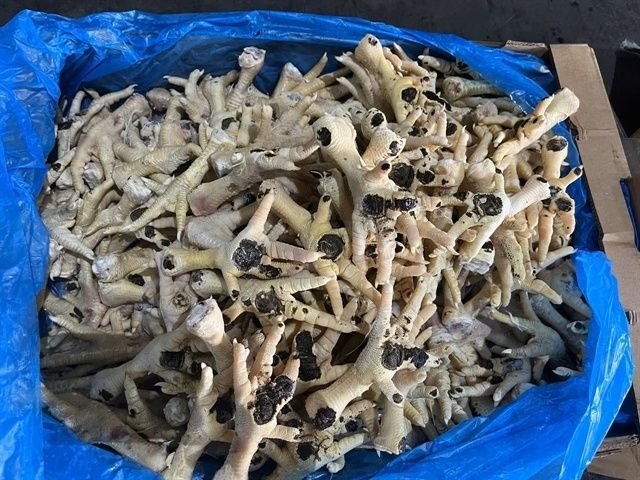
Hanoi police have formally charged two businesswomen with smuggling after uncovering an elaborate scheme to import and illegally distribute hundreds of containers of frozen chicken feet across Vietnam. The investigation reveals that between 2023 and 2026, the two suspects orchestrated the importation of 339 containers of poultry products originating from countries with active poultry diseases, circumventing biosecurity regulations and defrauding the state of import duties worth millions of dollars.
Nguyen Thi To Loan, aged 47, operated ABF Food Import-Export JSC in Ninh Binh Province and held primary responsibility for the smuggling operation. Her co-conspirator, Trang Tuyet Ngoc, 45, served as head of the assistant department at An Binh Group and facilitated the illegal distribution network. Both suspects have confessed to all charges levelled against them by law enforcement.
The scheme exploited a critical loophole in Vietnam's import regulations. While frozen poultry products from countries experiencing active poultry disease outbreaks are technically permitted entry into Vietnam, they are strictly limited to processing and subsequent re-export. The regulatory framework prohibits any domestic sale of such goods due to biosecurity risks and the potential spread of animal diseases. Nguyen Thi To Loan deliberately circumvented these safeguards by falsely declaring the shipments as intended solely for processing and re-export while secretly directing Trang Tuyet Ngoc to distribute the entire volume across the domestic market instead.
The scale of the illegal operation was staggering. Investigators discovered that more than 10,000 metric tonnes of frozen chicken feet were diverted to food-service businesses operating across multiple provinces including Hanoi, Cao Bang, Ninh Binh, and Quang Ninh. This widespread distribution meant that restaurants, food processors, and catering establishments throughout northern and central Vietnam unknowingly served products that violated import restrictions and potentially posed public health risks.
The financial dimensions of the crime underscore its severity. The total value of imported goods was calculated at approximately VNĐ347 billion, equivalent to US$13 million. Critically, no import duties were paid on any of these shipments, representing a substantial loss to state revenue. The customs fraud component adds another serious criminal dimension to what authorities initially classified as a smuggling matter.
Police raids on warehouses linked to the operation uncovered the physical extent of the stockpile. At the An Viet 2 freezer facility located in Hanoi's Quang Minh Industrial Zone, officers discovered over 1,000 metric tonnes of frozen chicken feet. Among this cache, approximately 260 metric tonnes had visibly deteriorated, displaying signs of mold and foul odours, yet appeared to have been prepared for market distribution. The storage of degraded food products intended for sale to consumers represents an additional public health violation and potential criminal negligence.
A second major seizure occurred at the THL cold-storage warehouse in Lang Son Province in northern Vietnam, where investigators recovered more than 1,030 metric tonnes of frozen chicken feet. The discovery of such substantial quantities across multiple facilities demonstrates the industrial scale of the illegal distribution network rather than small-scale opportunistic smuggling. The infrastructure required to receive, store, and distribute such volumes suggests coordination with wholesale and retail distribution chains across the region.
The investigation highlights vulnerability in Vietnam's food import and biosecurity systems. For Malaysian and Southeast Asian readers, this case demonstrates how determined criminal networks can exploit regulatory mechanisms and create serious public health risks across international supply chains. The cross-border movement of potentially contaminated food products without proper oversight endangers consumers across the entire region, particularly in informal food service sectors where traceability is minimal.
Hanoi police have formally charged both Nguyen Thi To Loan and Trang Tuyet Ngoc under Article 188 of the 2015 Penal Code, which addresses smuggling offences. The severity of charges reflects not only the monetary value of goods smuggled but also the deliberate violation of biosecurity protocols designed to protect public health. The confessions by both suspects may accelerate prosecution, though Vietnamese criminal procedure typically involves extensive investigation phases.
Authorities indicate that the investigation remains ongoing and expanding in scope. Police are working to identify additional individuals and organizations potentially involved in the broader smuggling network. This suggests the operation likely extended beyond the two primary suspects, possibly encompassing customs brokers, warehouse operators, and distribution intermediaries who facilitated the illegal movement and sale of contaminated poultry products. The web of complicity may ultimately involve numerous parties across Vietnam's food supply chain.
The case raises critical questions about enforcement mechanisms at Vietnam's borders and within its food distribution infrastructure. Similar vulnerabilities likely exist in other Southeast Asian nations where rapid economic development has outpaced regulatory capacity. For Malaysia and neighbouring countries, this incident serves as a cautionary reminder of the importance of maintaining rigorous biosecurity standards and implementing robust tracking systems for imported food products, particularly those from regions with disease concerns. Regional cooperation on food safety and customs enforcement may be essential to prevent such schemes from operating across multiple jurisdictions.

