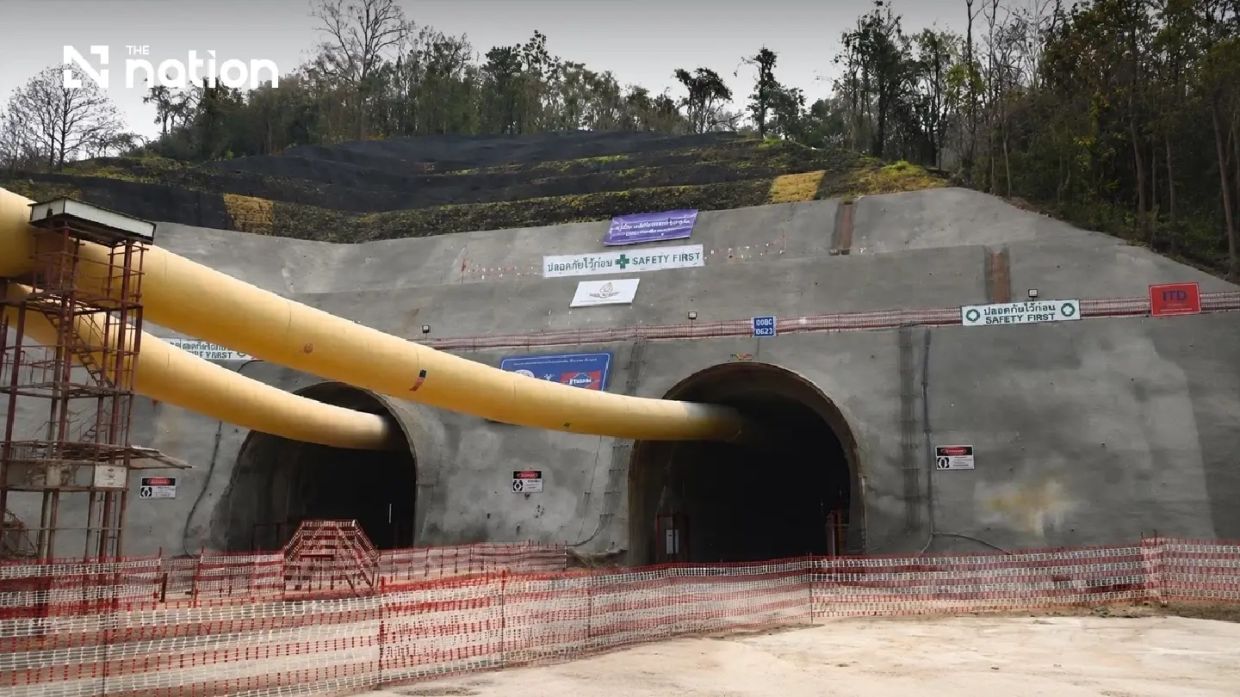
A construction accident at a major Thai railway project resulted in two deaths and multiple injuries when scaffolding collapsed inside the Doi Luang tunnel in Chiang Rai on Saturday evening. The incident, which unfolded at approximately 8.35pm, has brought fresh attention to workplace safety concerns on Thailand's high-profile rail development initiatives, particularly those aimed at strengthening transport connectivity across the northern region and into Southeast Asia.
The accident occurred during work on the Den Chai-Chiang Rai-Chiang Khong railway line, being developed by the State Railway of Thailand. Seven additional workers sustained injuries ranging from serious to minor, with all casualties transported to hospital for medical treatment. Deputy Transport Minister Siripong Angkasakulkiat disclosed that preliminary investigations suggest rocks dislodged from the tunnel wall caused the scaffolding failure whilst crews were applying waterproofing materials to the structure.
The 3.4-kilometre Doi Luang tunnel, situated in Chiang Saen district, had already been successfully excavated through the mountain before the disaster struck during its finishing phase. The tunnel forms a critical component of Contract 3 within the broader Chiang Rai-Chiang Khong section of the railway development. This particular contract, valued at THB19.385 billion, encompasses considerably more than tunnel completion alone.
The scope of Contract 3 reveals the ambition of this infrastructure venture. Beyond the Doi Luang tunnel itself, it includes construction of approximately 87 kilometres of both elevated and ground-level railway tracks, establishment of three stations and three additional halts, installation of comprehensive signalling and telecommunications systems, and various supporting infrastructure. The scale indicates that Thailand is pursuing not merely a tunnel construction project but a complete railway corridor designed to enhance regional trade and passenger movement.
The work is being executed by CKST-DC3 Joint Venture, a consortium bringing together three significant construction firms: Thailand's CH. Karnchang Public Company Limited, Sino-Thai Engineering & Construction Public Company Limited, and Chiangmai Construction Co., Ltd. The involvement of both Thai and Sino-Thai entities underscores the cross-border investment and cooperation characterising major Southeast Asian infrastructure development, reflecting broader patterns of Chinese infrastructure engagement throughout the region.
Immediate response to the incident appeared swift and organised. Deputy Transport Minister Siripong confirmed that the accident site had been secured and cordoned off to prevent further mishaps. The project's dedicated safety unit assumed direct control of the location and initiated close monitoring protocols. The State Railway's Special Projects and Construction Department mobilised to inspect the scene and gather evidence regarding the collapse sequence.
Whilst initial reports attributed the scaffolding failure to falling rocks, officials acknowledged that detailed investigation remained ongoing. Earlier preliminary accounts had referenced a collapse specifically within the shotcrete work area, suggesting the precise mechanism of failure may have involved multiple contributing factors. The investigation's evolution from initial reports to more detailed findings underscores how complex construction accidents often reveal layered causes rather than single points of failure.
This incident carries particular significance for Southeast Asian readers given the region's ambitious infrastructure agenda. The Chiang Rai-Chiang Khong railway represents part of broader connectivity initiatives designed to link southern China with Southeast Asian economies, facilitating trade and creating alternative transport routes. Such projects are strategically important but necessarily complex, involving challenging terrain, geological variables, and compressed timelines that can create safety pressures.
Construction fatalities remain a persistent challenge throughout Asia's rapid development phase. Thailand's workplace safety record, whilst improving, continues to lag developed economies. This accident, occurring during a finishing rather than excavation phase, suggests that tunnel completion work—often considered lower-risk than initial boring—presents hazards requiring equivalent vigilance and precaution. The presence of both serious and minor injuries alongside fatalities indicates that chance and individual positioning significantly influenced outcomes.
The implications for the broader project timeline remain uncertain. Whether this incident will cause scheduling adjustments or trigger additional safety reviews affecting other contract sections depends on investigation findings and any remedial measures deemed necessary. Thai authorities and the contractor consortium will face pressure to demonstrate that systematic safety improvements prevent recurrence, particularly given that this project embodies the kind of international infrastructure cooperation that Southeast Asian governments are actively promoting.
For Malaysian observers, the accident serves as a reminder that rapid infrastructure development throughout the region, whilst economically beneficial, demands sustained attention to worker protection and rigorous safety culture implementation. Thailand's experience with this particular contract will likely inform similar projects elsewhere in ASEAN, as countries increasingly share lessons from both successes and setbacks in major construction initiatives.

