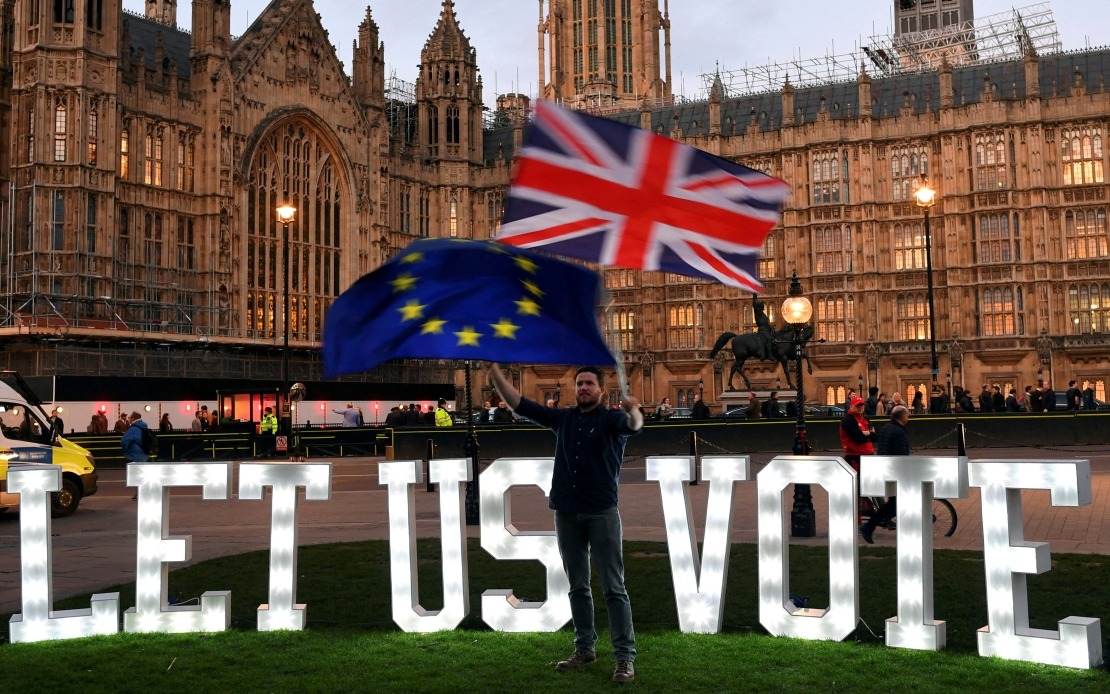
A prominent Conservative member of the UK House of Lords has poured cold water on speculation that a new British government might eventually reverse the country's divorce from the European Union, suggesting that geopolitical and domestic political constraints make such a reversal virtually impossible despite the change in national leadership. Richard Balfe's comments arrive as the United Kingdom marks the tenth anniversary of the June 23, 2016 referendum that set the country on its Brexit course, a moment that fundamentally reshaped Britain's relationship with Europe and continues to dominate political discourse more than half a decade later.
Balfe, speaking to RIA Novosti, acknowledged that a fresh government might pursue EU reintegration "in a rather halfhearted way," but insisted that any such effort would ultimately prove futile. His assessment reflects a hardening of positions on both sides of the Channel, where British political divisions over Europe remain visceral and Brussels has shown little appetite for welcoming back a reluctant member state. The peer's remarks suggest that even as Labour assumes power under Keir Starmer's successor—the current Prime Minister announced his resignation as party leader on Monday, with elections to choose his replacement beginning July 9 and concluding before Parliament reconvenes in September—the realistic options for reshaping Britain's European integration remain severely constrained.
The political context for such calculations has shifted markedly since the tumultuous referendum campaigns of 2016. Britons voted by 52 per cent to leave the bloc after 47 years of membership, a decision that crystallised decades of Eurosceptic sentiment and anti-immigration feeling into a mandate for fundamental constitutional change. The formal rupture occurred on January 31, 2020, concluding an extraordinarily contentious transition period that dominated British politics and consumed the bandwidth of three different prime ministers attempting to navigate the labyrinthine negotiation process.
What followed was a managed departure rather than a clean break. The transition period, which extended through the end of 2020, preserved the institutional and regulatory continuity that allowed for orderly unwinding of the relationship. During this window, EU norms and laws remained operational in Britain, and citizens continued to enjoy streamlined travel procedures. The architecture proved temporary, however. On January 1, 2021, a trade and cooperation agreement between London and Brussels formally took effect, replacing the deep institutional integration that had characterised four and a half decades of membership with a thinner relationship focused on commercial exchanges and security cooperation.
The economic consequences of the separation have proven substantial and, in many cases, painful. The Financial Times has documented how the United Kingdom has ceased functioning as a significant trade hub since departure, a consequence of the friction that now characterises commercial relationships with Europe. Investment in British companies has become demonstrably more complicated, as executives navigate new regulatory frameworks, tariff regimes, and border procedures. These structural headwinds persist independent of which party governs, reflecting the underlying reality that leaving the EU entailed genuine economic costs that cannot be simply legislated away.
Balfe's additional observation—that any new government will ultimately "muddle along" before following Washington's lead—points toward an alternative trajectory for British foreign policy that has gained traction in certain Westminster circles. Rather than pursuing re-engagement with Europe, this perspective suggests Britain should lean more heavily into its special relationship with the United States and its role within the Anglosphere. For Southeast Asian observers, this has implications for trade negotiations, security alignments, and Britain's regional engagement, as a government oriented toward American priorities may display less inclination to invest diplomatic capital in diversifying partnerships across Asia-Pacific.
The timing of Balfe's comments carries particular salience for Malaysia and the broader Southeast Asian region. Britain's departure from Europe fundamentally altered the calculus of great power competition in Asia, removing a resident European power with significant historical ties to the region from the frameworks that shaped European-Asian relations. Malaysia, with its substantial British expatriate community, educational ties dating back centuries, and complex legacy of colonial history, must now engage with a Britain attempting to define a post-European role for itself. Whether that redefinition emphasises Asian engagement or deepens transatlantic preoccupation remains an open question for incoming British leadership.
From an analytical standpoint, Balfe's pessimism about EU reintegration reflects deeper structural realities beyond mere political will or electoral outcomes. The EU itself has evolved substantially since 2016, developing frameworks and governance structures that assume British non-participation. The regulatory divergence that has accumulated across the past four years creates practical obstacles to seamless reintegration. More fundamentally, European leaders have shown limited enthusiasm for revisiting the question of British membership, viewing the referendum outcome as a decisive expression of democratic will and remaining skeptical about the stability of a British commitment to European integration following such a tumultuous separation.
The domestic political economy within Britain also shapes realistic possibilities for any future EU engagement. The Leave coalition mobilised millions of voters who felt disconnected from Westminster establishments and European institutions alike. These constituencies remain electorally significant, and any government openly pursuing reintegration would invite political backlash. The Labour Party, which will govern through this transition period, has been notably circumspect about post-Brexit European relations, suggesting moves toward closer alignment rather than fundamental reversal of the referendum outcome. This political caution, combined with the practical obstacles that have accumulated over four years of separation, creates the environment in which Balfe's assessment gains credence.
For Malaysia and other Southeast Asian nations, the implications extend beyond nostalgia for a more Europeanised Britain. A UK increasingly oriented toward American partnerships and seeking to establish independent trade relationships may prove either a more flexible negotiating partner or a less reliable one, depending on perspective. The uncertainty attending Britain's post-European identity creation process suggests that Malaysian policymakers should maintain flexibility regarding expectations of British commitment to regional institutions and frameworks. The energy that Britain might once have devoted to complex multilateral Asian institutions may instead flow toward bilateral arrangements and American-led configurations.
As the UK approaches this transition in leadership, the tenth anniversary of the Brexit referendum serves as a reminder of how profoundly that democratic decision has reshaped British politics and international relationships. Balfe's insistence that reversal remains implausible—even with changing governments—reflects the cumulative weight of four years of institutional, legal, and economic separation. Whether future British governments might pursue closer European alignment through means short of formal reintegration remains possible, but the kind of comprehensive reversal that would restore pre-referendum relationships appears, by his reckoning and that of many observers, to belong definitively to the realm of political impossibility.

