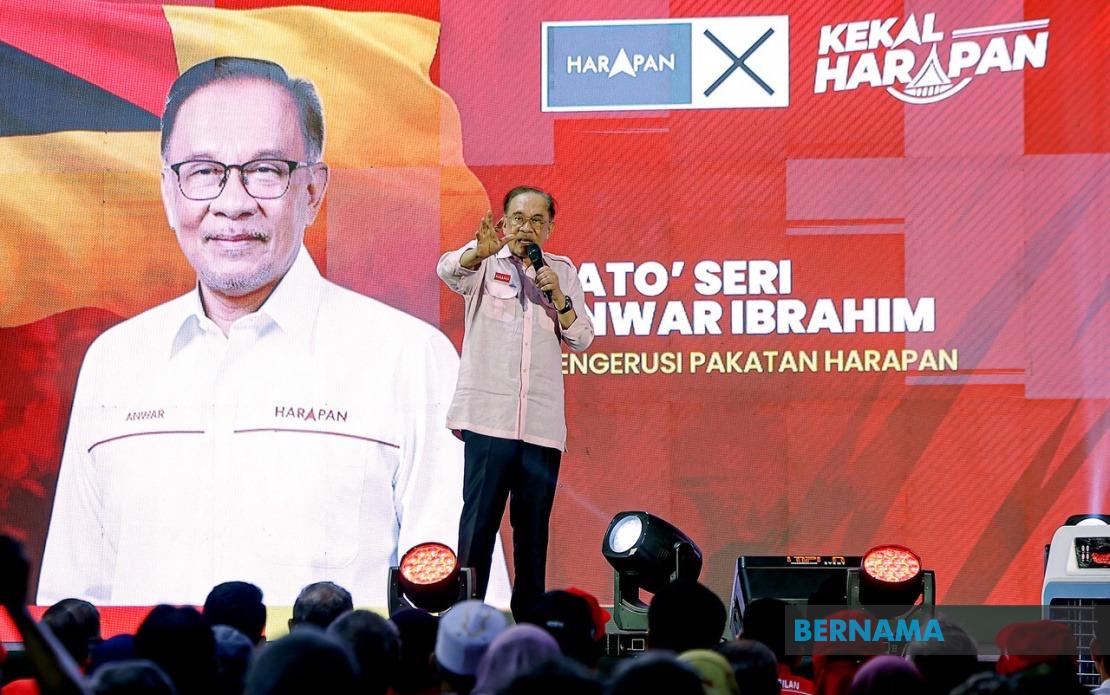
Prime Minister Datuk Seri Anwar Ibrahim has moved to reassure Malaysia's business community and international investors that the Unity Government maintains rock-solid stability at the federal level, even as coalition partners prepare for competitive elections across the country's states. Speaking in Seremban on July 22, Anwar emphasised that the administration's structural integrity remains uncompromised, allowing the government to pursue its economic agenda without disruption or policy uncertainty.
The Prime Minister's statement comes at a moment when Malaysia's political landscape faces heightened scrutiny. Whilst state-level electoral contests inevitably pit coalition members against one another—with Pakatan Harapan, Barisan Nasional, and their allies jockeying for territorial advantage—Anwar sought to draw a clear distinction between this expected state-level competition and the federal apparatus. This separation of concerns reflects a deliberate political strategy to insulate Putrajaya's decision-making machinery from the friction generated by campaigns at the ground level.
Anwar highlighted the smooth functioning of Cabinet proceedings as evidence of underlying cohesion. He pointed to recent ministerial meetings featuring Agriculture and Food Security Minister Datuk Seri Mohamad Sabu, Transport Minister Anthony Loke, Deputy Prime Minister Datuk Seri Dr Ahmad Zahid Hamidi, and other senior figures, noting that these gatherings proceed according to schedule without impediment. The regularity and efficiency of such meetings signal to both domestic constituencies and foreign investors that executive machinery continues to operate without the friction that might be expected from a coalition spanning ideologically diverse parties.
For Malaysia's investment community, such assurances carry considerable weight. Foreign direct investment and private capital flows depend heavily on perceived political stability and the consistency of economic policy frameworks. Any signal of federal-level fragmentation could prompt investors to recalculate their risk profiles and potentially defer expansion plans or redirect capital to perceived safer jurisdictions elsewhere in Southeast Asia. Anwar's explicit reference to investor confidence underscores the administration's awareness that politics and commerce remain intimately linked in Malaysia's contemporary economic ecosystem.
The phrase "at the state level there might be issues" functioned as a tacit acknowledgement that electoral rivalry generates real tensions within the coalition. Such candidness itself serves a purpose—by acknowledging what observers already perceive, Anwar preempts narratives suggesting the government operates in denial about ground-level realities. Simultaneously, by immediately pivoting to assurances about federal stability, he frames state-level complications as manageable and compartmentalised rather than symptomatic of systemic decay.
The Unity Government's genesis lay in the necessity of building a broad coalition following the 2022 general elections, when no single bloc secured an outright parliamentary majority. This architectural reality—wherein partners with different policy preferences and competing regional ambitions must cooperate at the centre—creates inherent tensions that become more pronounced during electoral cycles. The challenge for Anwar's administration involves maintaining operational consensus on major economic initiatives whilst permitting coalition members sufficient autonomy to contest elections against one another without triggering a domino effect of defections or institutional sabotage.
Economic growth particularly hinges on policy consistency and the predictability that investors require for medium to long-term planning. Malaysia's recovery trajectory following pandemic disruptions demands sustained policy coherence around fiscal management, infrastructure development, and structural economic reforms. Should federal-level governance succumb to factional paralysis, the consequences would reverberate across export-dependent sectors, foreign investment flows, and employment dynamics in an already competitive regional environment where Vietnam, Thailand, and Indonesia all vie for capital and manufacturing relocations.
Anwar's invocation of "Insha'Allah" in expressing hope that federal stability persists post-election carried additional significance. This phrasing reflected the Prime Minister's characteristic blending of Islamic and secular political discourse, framing governmental stability as both a practical necessity and a matter of collective intention. It also subtly conveyed that maintaining coalition equilibrium requires ongoing cooperation and goodwill from all member parties rather than being an automatic or guaranteed outcome.
The timing of these remarks, made during what would ordinarily be a busy electoral preparation period, suggests deliberate political positioning. By securing the narrative early, Anwar seeks to establish expectations among investors, civil servants, and international observers that federal institutional resilience will endure regardless of electoral outcomes at state level. This framing potentially influences how market actors respond to political developments and how international rating agencies assess Malaysia's sovereign credit risk during a period of heightened political activity.
Looking forward, the true test of federal-level stability will emerge in the post-election period. Should significant electoral shifts alter the parliamentary balance or create new coalition configurations, the architectural principles underpinning current arrangements would require renegotiation. For now, however, Anwar's message attempts to project business-as-usual continuity, even as coalition members prepare for electoral contests that could substantially reshape state-level political geography and potentially influence their relative bargaining power within any subsequent federal arrangement.
The sustainability of the Unity Government ultimately depends on coalition partners concluding that shared power and coordinated federal governance serve their interests better than pursuing alternative configurations. So long as this calculus holds and no single bloc perceives opportunity for unilateral advantage, the federal platform can likely accommodate state-level competition without experiencing structural collapse. Anwar's comments thus function as both reassurance to external stakeholders and reinforcement of the internal logic sustaining the coalition.

