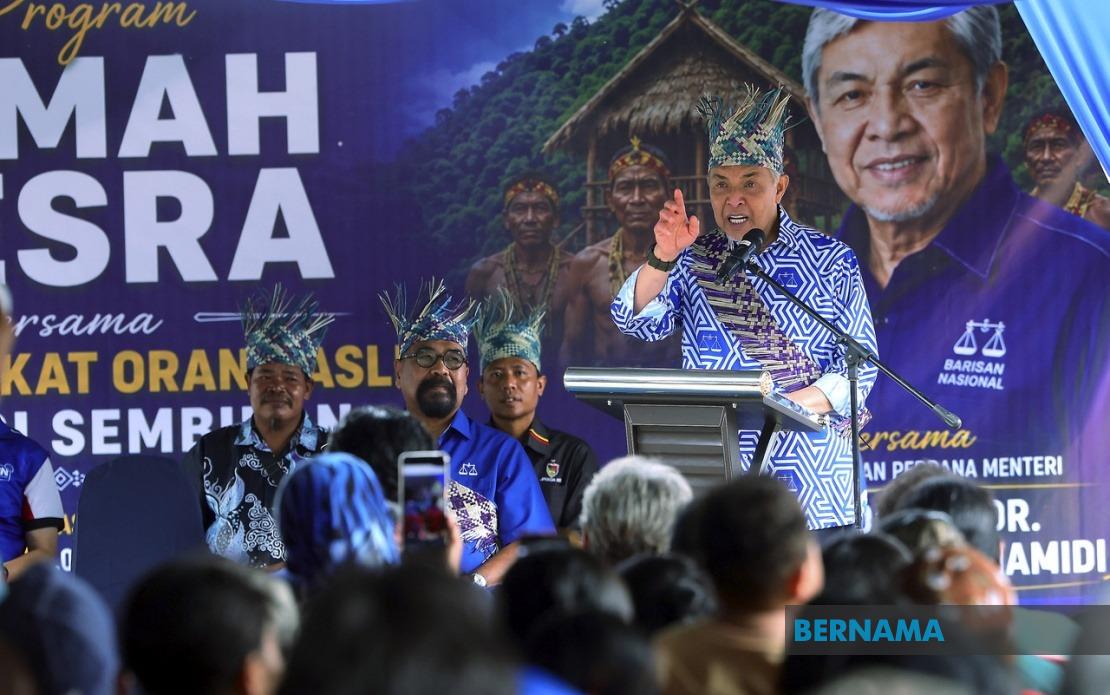
The Unity Government's commitment to maintaining its federal coalition will persist regardless of electoral outcomes at the state level, according to Barisan Nasional chairman Datuk Seri Dr Ahmad Zahid Hamidi. Speaking in Jelebu following a community engagement session, the Deputy Prime Minister underscored that the stability of Malaysia's national administration takes precedence over individual state-level contests, signalling that intra-coalition tensions will not destabilise the broader political arrangement that has governed since 2022.
Ahmad Zahid's statement arrives as voters in Negeri Sembilan prepare to cast ballots on August 1, with early voting scheduled for July 28. The timing of his reassurance reflects ongoing scrutiny of whether state electoral results might trigger shifts in federal alignments or trigger friction between BN and its coalition partners within the Unity Government framework. By explicitly divorcing state electoral performance from federal commitment, Ahmad Zahid has attempted to establish clear boundaries between parliamentary and regional politics, a distinction that historically has proven difficult to maintain in Malaysian political dynamics.
The Deputy Prime Minister emphasised that BN's coalition partnership with other Unity Government members rests on formal agreements and collective resolutions transcending temporary fluctuations in state-level popularity. This procedural anchoring suggests that the governing coalition has sought to insulate itself from the volatility that typically accompanies state elections, where component parties often experience differential electoral fortunes. By framing the commitment as binding and non-negotiable, Ahmad Zahid has positioned the coalition as institutionally robust rather than contingent upon successive electoral validations.
Relations between Ahmad Zahid and Prime Minister Datuk Seri Anwar Ibrahim remain functional and cordial, according to the BN chairman's assessment. This characterisation carries significance given the historical tensions between their respective political trajectories and the occasional friction that has surfaced within the unity framework. The explicit reference to a healthy working relationship serves to reassure party members and coalition partners that despite occupying different political traditions, Malaysia's top two executives have established sufficient professional rapport to navigate governance challenges collaboratively. Such declarations become particularly important during election periods when perceptions of internal discord could undermine voter confidence in the coalition's capacity to govern effectively.
Ahmad Zahid articulated the coalition's operating premise as maintaining a clear separation between state and federal spheres of political concern. National-level governance, he suggested, proceeds according to its own logic and priorities independent of state election trajectories. This compartmentalisation reflects a deliberate strategy to protect the federal alliance from the churning nature of state politics, where different demographic compositions, regional identities, and local grievances produce electoral outcomes that may diverge significantly from national popularity metrics. By establishing this conceptual boundary, Ahmad Zahid has sought to prevent cascading consequences whereby state defeats trigger reassessments of federal arrangements among coalition partners.
The absence of fundamental disagreements regarding national policy directions appears to be a cornerstone of the coalition's stability according to Ahmad Zahid's framing. Malaysia's Unity Government encompasses diverse political entities spanning the spectrum from conservative Islamic-oriented parties to progressive urban-focused movements, making ideological coherence a persistent challenge. The claim that no substantive policy disagreements exist on core national issues suggests that the coalition has either successfully negotiated a consensual platform or has compartmentalised its policy agenda to avoid triggering contentious debate. Either scenario reflects a pragmatic approach to coalition management where maintaining administrative continuity takes precedence over pursuing transformative policy agendas that might expose ideological fissures.
The Negeri Sembilan state election itself involves BN contesting multiple seats, with Datuk Seri Jalaluddin Alias running as the party's candidate for the Pertang state seat and Siow Kong Choon representing BN in Chennah. These individual contests will generate their own dynamics and local narratives, yet Ahmad Zahid's framing positions them as peripheral to the broader question of federal governance. This approach potentially shields senior leadership from accountability for state-level performance while simultaneously signalling that national stability transcends regional political outcomes. For Malaysian voters, this distinction raises questions about whether federal stability genuinely operates independently or whether state electoral results will inevitably influence coalition dynamics despite leadership assurances.
From a Southeast Asian perspective, Malaysia's experiment with multi-bloc coalition governance carries broader implications for regional stability and democratic practice. The Unity Government represents an attempt to accommodate diverse political forces within a single administrative framework without requiring ideological convergence or organisational integration. If such arrangements can be sustained across electoral cycles, they potentially offer a model for managing plural societies with fractious political landscapes. Conversely, if state elections trigger federal realignments or if coalition commitments prove contingent upon electoral performance, the model may reveal fundamental limitations in maintaining stability across multiple governance levels simultaneously.
The coordination mechanisms through which the Unity Government manages its internal diversity remain incompletely transparent to external observers. Ahmad Zahid's characterisation of relationships as professional and cordial provides limited insight into the institutional arrangements, power-sharing formulas, or dispute resolution procedures that enable coalition partners to coexist without generating paralyzing conflict. Understanding these mechanisms would assist Malaysian voters in assessing the coalition's genuine durability versus its rhetorical commitments to stability. The upcoming Negeri Sembilan election will provide an early test of whether these mechanisms can withstand the stresses that electoral outcomes typically impose on political alliances.
For BN specifically, maintaining the federal coalition while competing against other political forces in state elections presents distinctive challenges. The party must project strength and independence to state electorates while simultaneously demonstrating loyalty to its federal alliance partners. This balancing act becomes particularly delicate in contests where opposing coalitions seek to exploit any appearance of division within government ranks. Ahmad Zahid's unambiguous reaffirmation of commitment attempts to preempt opposition attempts to weaponise state-level friction, though such declarations often prove insufficient to prevent perceptions of internal tension from influencing voter behaviour.
The broader trajectory of Malaysian coalition politics over the coming months will determine whether Ahmad Zahid's current assurances translate into sustained institutional practice. State election outcomes across the federation, potential shifts in party alignments at the grassroots level, and the emergence of novel political issues could all test the Unity Government's cohesion. If the coalition successfully navigates multiple rounds of state elections while maintaining federal stability, it would represent a significant achievement in managing political pluralism. If state results trigger repositioning among coalition members or prompt reassessments of partnership arrangements, the current assurances will retrospectively appear as expressions of optimistic intent rather than forecasts of actual political behaviour.

