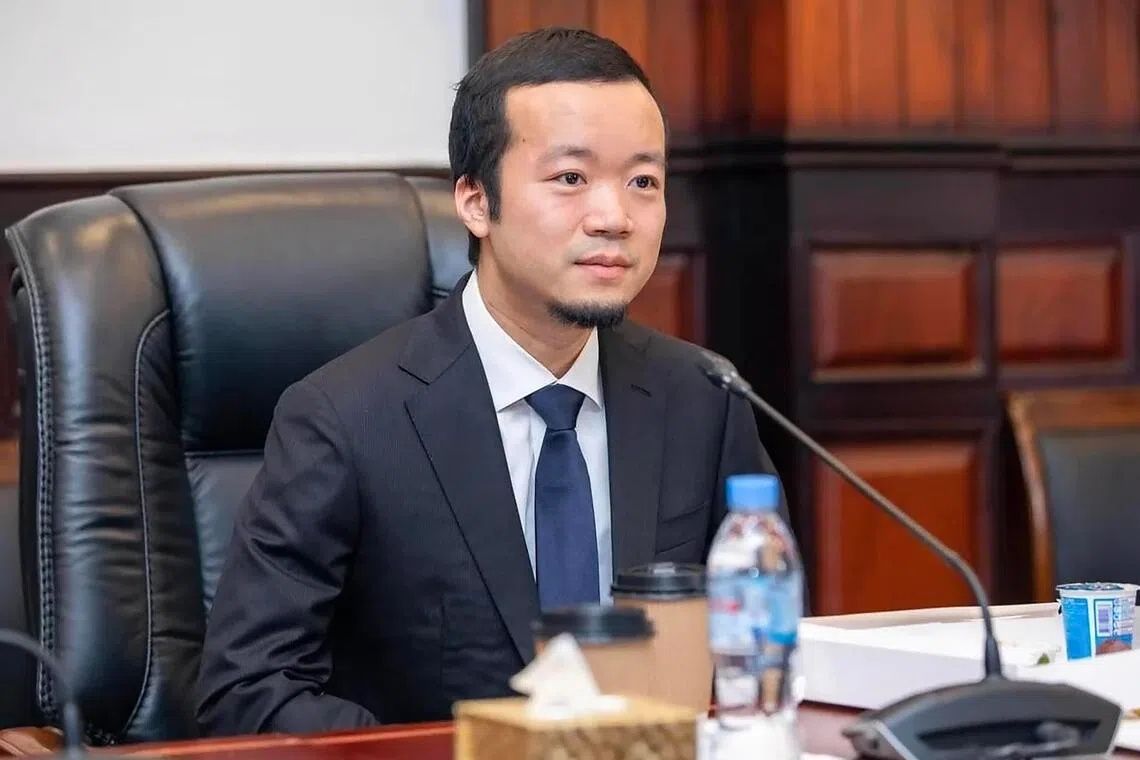
Authorities have identified Chen Sokly as a principal co-conspirator in what prosecutors describe as one of the most extensive financial fraud operations in modern history, following a criminal indictment filed in New York on October 8, 2025. Operating under multiple identities across several countries, Sokly served as a trusted lieutenant to Chen Zhi, the mastermind behind the Prince Holding Group—a sprawling criminal network accused of orchestrating investment fraud and money laundering on a staggering scale. The identification of Sokly represents a significant breakthrough in piecing together the architecture of this global crime empire, which derived its wealth from systematically victimising foreign workers forced into illegal operations within Cambodian scam compounds.
A six-month collaborative investigation by The Straits Times and the Organised Crime and Corruption Reporting Project examined hundreds of official documents, corporate records, and property filings across multiple jurisdictions to unmask the second identified co-conspirator. The research effort uncovered an intricate lattice of shell companies and sophisticated money-laundering mechanisms that enabled the Prince Group to cycle billions of dollars through legitimate-appearing business entities and real estate investments. Sokly's own financial footprint—stretching from Silicon Valley properties to luxury Singapore real estate—provides a window into how the syndicate converted ill-gotten gains into seemingly legitimate assets whilst maintaining the appearance of conventional wealth accumulation.
Born in Shanghai in 1986 as Chen Xing, Sokly reinvented himself by acquiring Cambodian citizenship around the end of 2017, according to records published in the Cambodian government gazette. He subsequently obtained citizenship in Cyprus as well, establishing a pattern of jurisdictional hopping that became characteristic of Prince Group operatives. Verification of his identity required painstaking cross-referencing of corporate records, acquisition of citizenships, and residential histories spanning Singapore, the United States, and Southeast Asia. Among Singapore business circles, he cultivated a persona as Martin Chen, a wealthy businessman with diverse investment interests—a carefully constructed cover that masked his role as the syndicate's chief enforcer and risk management officer.
Within the Prince Group hierarchy, Sokly occupied a position of considerable trust and influence. Chen Zhi tasked him with overseeing the syndicate's risk control function, effectively making him responsible for monitoring law enforcement activities and neutralising threats to the organisation's operations. Documents uncovered during the investigation reveal that Sokly actively engaged in corrupt practices designed to insulate the syndicate from prosecution. In May 2023, he allegedly communicated with a Chinese government official who promised to shield Prince Group members from legal consequences, with Sokly undertaking to provide personal favours in return. The arrangement extended to directing the same official to instruct local police officers to conduct extortion operations on the syndicate's behalf, demonstrating the calculated corruption that permeated the organisation's dealings with officials.
Sokly's confidence in his networks of compromised officials became legendary within the Prince Group structure. When Cambodian authorities began targeting scam compounds in the country, Sokly dismissed concerns about enforcement actions, assuring other members that the Prince Group possessed sufficient political protection to weather any crackdown. Internal communications and ledgers seized by US authorities documented extensive discussions between Chen Zhi and Sokly regarding the number of officials they maintained on the payroll. A bribery ledger kept by Chen Zhi revealed that in 2019 alone, Sokly purchased a yacht valued in excess of US$3 million as a gift for a foreign government official—a transaction that exemplified the scale of financial inducements the syndicate deployed to secure official protection and cooperation.
Beyond corruption and bribery, Sokly also functioned as the Prince Group's enforcer, employing violence and intimidation to maintain discipline within the sprawling criminal network. When members attempted to pilfer funds or deviate from the syndicate's operations, Sokly was summoned to handle discipline. In July 2024, Chen Zhi specifically directed associates to contact Sokly regarding a group member suspected of theft, underscoring Sokly's role as the organisation's chief instrument of coercion. Sokly frequently boasted about the syndicate's operational capacity and global reach, once claiming that the Prince Group was generating approximately US$30 million daily through its various illicit activities—a figure that suggests the scope of the criminal enterprise vastly exceeded public understanding at the time.
Property records obtained from California reveal that Sokly purchased a residence in that state in 2019 from Fang Zhizhen, a member of the Knight Attack Group, an earlier cybercriminal organisation that preceded and likely influenced the Prince Group's operational model. Fang's subsequent identification in the same Office of Foreign Assets Control (OFAC) sanctions list underscores how interconnected these criminal networks had become. Sokly sold that California property in 2024 for approximately US$4.5 million, suggesting he was managing his American asset portfolio even as federal authorities closed in on the syndicate. Further complicating the picture, Sokly transferred ownership of another American property valued at US$4 million to his wife on November 4, 2025—just weeks after OFAC sanctions against the Prince Group were announced. The property was subsequently placed in a trust controlled by his wife in December 2025, a manoeuvre consistent with asset-concealment strategies employed by individuals anticipating government seizure.
Singapore held particular significance in Sokly's financial architecture. In 2017, he announced his arrival in the city-state by purchasing an S$11 million apartment spanning 5,694 square feet at 10 Leedon Heights, one of the island's most prestigious residential addresses. Within months, he incorporated M Capital Global Holdings, his initial Singapore venture, into which he and his wife invested just over S$5 million in equal shares. The couple remained the company's shareholders, maintaining a veneer of legitimate business ownership. Over the subsequent two years, Sokly registered himself as a director of at least 16 Singapore companies, though he systematically removed his name from most of these entities between 2020 and 2023—a pattern suggesting an effort to distance himself from these vehicles as regulatory scrutiny intensified. Many of these firms shared a Shenton Way address, though on-site investigation revealed only two companies occupying space at that location, with no apparent connection to Sokly's operations.
Accounts from former employees who worked in proximity to Sokly reveal operational patterns consistent with someone managing a geographically dispersed criminal empire. Sokly typically spent between two and three months annually in Singapore, using his time in the city primarily for entertainment and relationship maintenance with other Prince Group operatives, including Chen Zhi himself. His evenings were frequently devoted to socialising with associates at drinking establishments, venues that likely served dual purposes as informal meeting spaces where sensitive matters could be discussed away from formal office environments. His material lifestyle in Singapore befitted his assumed role as a wealthy businessman: he maintained a fleet of luxury vehicles at his Leedon Heights residence, including a Bentley and a bespoke seven-seater vehicle, symbols of conspicuous wealth that reinforced his carefully constructed facade.
The identification and exposure of Chen Sokly carries significant implications for Southeast Asian financial regulators and law enforcement agencies. The Prince Group's ability to establish and operate networks of shell companies and luxury real estate holdings across multiple jurisdictions, including Singapore, suggests serious gaps in beneficial ownership verification mechanisms and cross-border information sharing among financial authorities. For Malaysian readers and policymakers, the case underscores the vulnerability of real estate markets and corporate registration systems to exploitation by organised crime networks. As the region continues to enhance anti-money laundering frameworks, the Sokly investigation provides a cautionary case study in how sophisticated criminals exploit differences in regulatory stringency and information-sharing protocols between jurisdictions. The fact that such operations flourished relatively openly in Singapore's tightly regulated environment raises uncomfortable questions about the sophistication of modern money-laundering techniques and the adequacy of current detection mechanisms.

