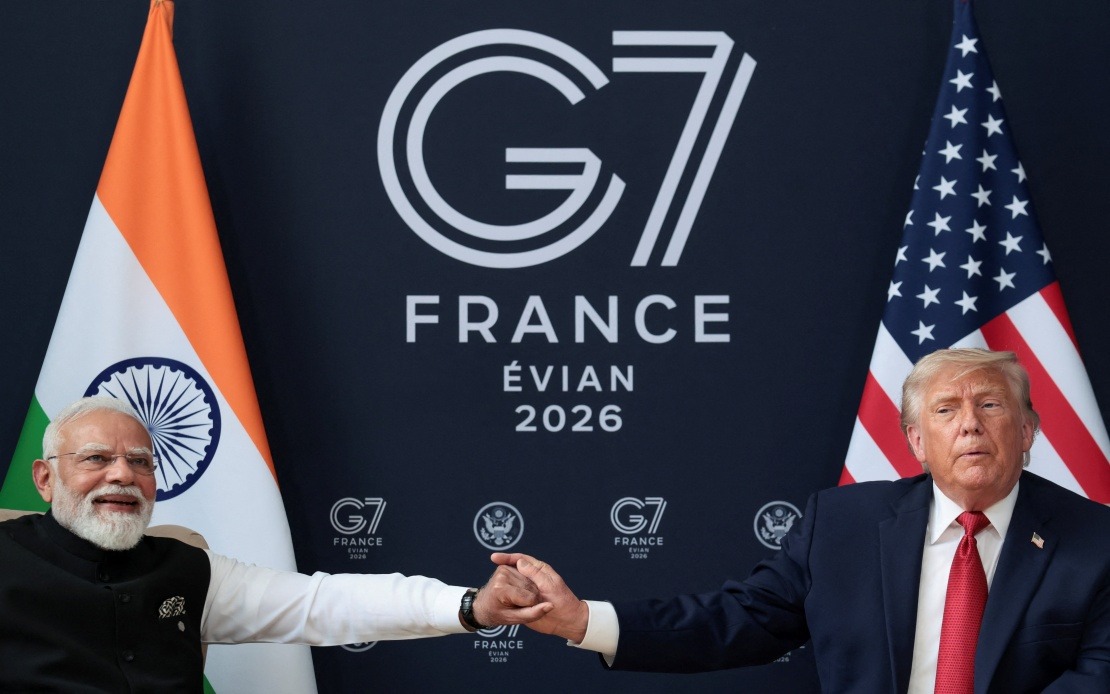
The United States and India have announced significant momentum in their protracted efforts to conclude a comprehensive bilateral trade agreement, with both nations signalling optimism about reaching a settlement in the coming weeks. The statement came following a meeting between Indian Prime Minister Narendra Modi and US President Donald Trump on the sidelines of the Group of Seven summit held in Evian, France, marking the highest-level engagement between the two economic powers on this contentious matter.
India's External Affairs Ministry released a formal statement indicating that the leaders had noted "with particular satisfaction" the advancement achieved throughout the negotiation process. Rather than leaving the momentum to chance, both Modi and Trump have explicitly instructed their respective trade teams to accelerate efforts toward finalising what officials describe as a "balanced, mutually beneficial, and commercially meaningful agreement at the earliest" possible time. This directive reflects recognition that protracted trade disputes create uncertainty for businesses operating across both economies and investors watching the relationship closely.
The significance of this development extends beyond diplomatic pleasantries. Trade relations between Washington and New Delhi have been marked by considerable friction in recent years, with multiple rounds of tariff impositions creating friction in what has traditionally been a strategic partnership. The instructive language used by both leaders suggests genuine commitment to closing gaps that have previously stalled negotiations, though specific details about contentious items remain undisclosed.
A crucial signal of earnest intent came with the announcement that US Trade Representative Jamieson Greer will undertake a visit to India within the following seven days. This planned visit, scheduled in immediate succession to the G7 conversations, suggests that officials are capitalising on the momentum generated by the summit dialogue and expect substantive progress during ground-level discussions. Such high-level envoy visits typically indicate advanced stages of negotiation where technical details can be ironed out with direct engagement.
President Trump's characterisation of Modi during their encounter provides insight into the dynamic between the two leaders. When questioned about the ongoing talks, Trump remarked that Modi represents one of the toughest negotiators he has encountered, despite acknowledging that the Indian leader presents an outwardly benign appearance. This backhanded compliment, while colourful in expression, underscores the nature of hard-nosed commercial negotiations where both sides have pursued their national interests vigorously. The observation also reflects mutual respect between the leaders, suggesting personal chemistry that can facilitate breakthrough moments in difficult discussions.
Historically, India and the United States reached an interim trade agreement in February of this year, which represented a partial thawing of escalating tensions. Under the terms of that preliminary accord, the US agreed to reduce certain tariffs to 18 per cent, offering meaningful relief to Indian exporters facing duties on valued goods. However, this interim arrangement has not resolved the underlying issues that have prompted repeated cycles of tit-for-tat tariff increases and retaliatory measures.
Context for the current diplomatic efforts includes the unilateral tariff regime Trump implemented at the beginning of 2025, which imposed a 25 per cent duty on Indian goods generally, with an additional 25 per cent penalty specifically targeting purchases of Russian oil. These measures reflected broader US foreign policy objectives regarding sanctions against Russia following the Ukraine conflict, but they created particular hardship for India, which has maintained significant energy trade relationships with Moscow. The burden of dual tariffs has pressured Indian policymakers and commercial interests to prioritise resolution of trade disputes with Washington.
For Malaysian readers and Southeast Asian observers, the resolution of US-India trade tensions carries meaningful implications. Both nations serve as anchor economies within the broader Indo-Pacific region, and trade disruptions between them create ripple effects throughout regional supply chains. Indian exports of pharmaceuticals, textiles, and agricultural products that transit or compete in Southeast Asian markets are affected by tariff regimes imposed by Washington. Similarly, Indian demand for regional goods fluctuates based on economic confidence, making the health of US-India trade relations consequential for economies throughout the Association of Southeast Asian Nations.
The emphasis placed on achieving a "commercially meaningful" agreement suggests negotiators are aiming for substantive content rather than symbolic gestures. This language indicates commitment to addressing specific sectoral concerns, probably spanning agriculture, pharmaceuticals, textiles, and manufactured goods where substantial trade flows occur between the two countries. Balancing these interests while maintaining overall commercial benefit requires sophisticated deal-making that addresses both nations' strategic priorities and protects politically sensitive industries.
The timing of this diplomatic push coincides with broader recalibration of US foreign policy priorities under the Trump administration. Strengthening the US relationship with India represents a core component of Washington's Indo-Pacific strategy, aimed at building counterweights to Chinese economic and strategic influence. A successful trade agreement would reinforce security and strategic partnerships between the two democracies while demonstrating that commercial disputes need not derail broader geopolitical alignment.
Beyond the immediate bilateral impact, resolution of US-India trade tensions could influence dynamics across the region. A comprehensive agreement might serve as a template for how Washington manages trade relationships with other strategic partners, potentially offering pathway models for resolving disputes through structured negotiation. It would also contribute to broader economic stability within the Indo-Pacific region, reducing uncertainty that has constrained business investment decisions throughout 2024 and early 2025.
Moving forward, the success of these negotiations will depend on whether negotiators can overcome remaining stumbling blocks that have resisted previous resolution efforts. The presence of Trump's trade team in India within days of the G7 summit suggests that both sides believe breakthrough is achievable. The comprehensive nature of what appears to be contemplated—moving beyond an interim arrangement to a fully implemented agreement—indicates ambitions to establish a stable, long-term commercial framework rather than perpetuating temporary measures.