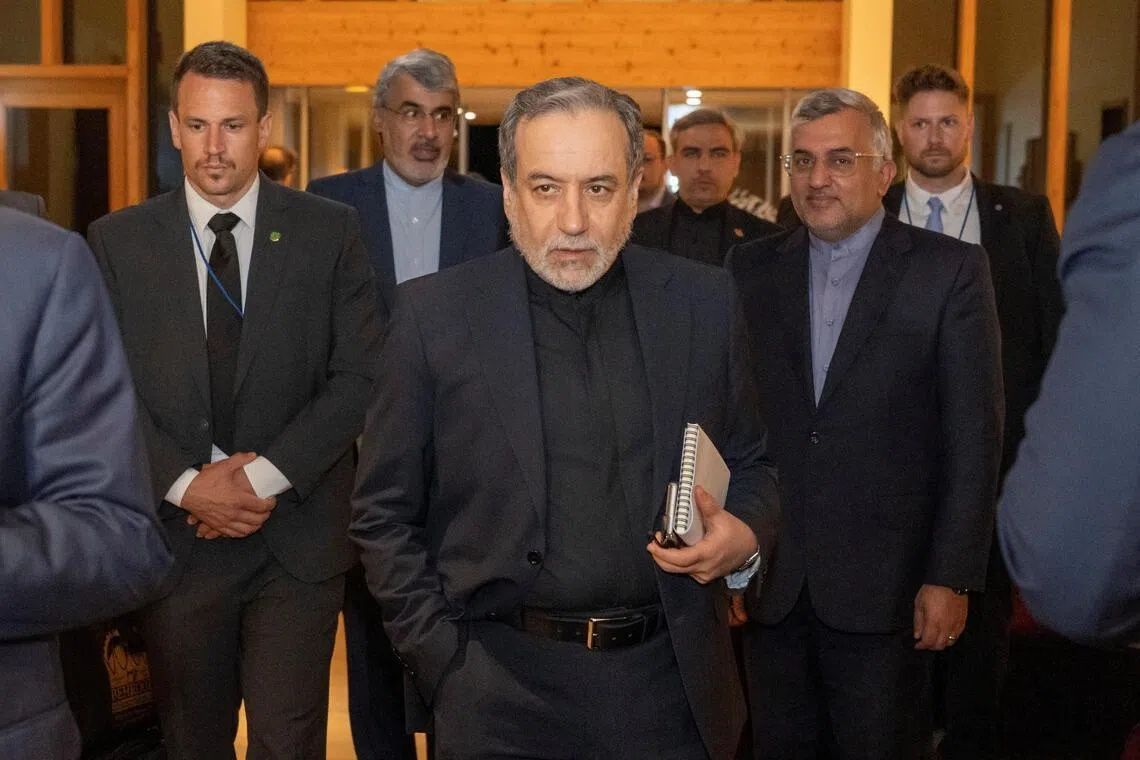
High-level negotiations between the United States and Iran commenced on Sunday morning at the Buergenstock resort in Switzerland, marking a significant diplomatic moment in efforts to resolve months of escalating regional conflict. Vice President JD Vance arrived to lead the American delegation, while Iranian chief negotiator Mohammad Baqer Qalibaf headed Tehran's team, with both nations seeking to transform an interim ceasefire agreement signed Wednesday by Presidents Donald Trump and Masoud Pezeshkian into a lasting settlement. The Swiss mountaintop venue, accessible only through winding mountain roads and multiple security checkpoints, provided a neutral and secure location for what both sides hope will be substantive discussions over several days.
The talks build upon a preliminary accord mediated by Pakistan that ended nearly four months of active warfare between the two nations. However, the opening phase of negotiations immediately encountered complications stemming from conflicting claims about the status of the Strait of Hormuz, one of the world's most critical energy chokepoints. Iran's Islamic Revolutionary Guard Corps declared on Saturday that it had closed the strategic waterway in response to Israeli military operations targeting positions in Lebanon, effectively claiming to restrict one-fifth of global oil supply flows. American military officials contested this assertion, reporting that 55 merchant vessels successfully transited the strait on Saturday, collectively carrying over 17 million barrels of crude and refined products destined for international markets.
The dispute over the Strait of Hormuz carries profound implications for global energy security and represents a fundamental disagreement about implementation of the ceasefire framework even before substantive negotiations began. Iran's Revolutionary Guards justified the closure announcement by accusing Israel of conducting military strikes in Lebanon that violated the spirit of the broader ceasefire agreement, suggesting that Tehran views American enforcement of the deal as inadequate. Mohammad Mokhber, a senior adviser to Ayatollah Mojtaba Khamenei, explicitly stated that Iran would maintain restrictions on energy flow until the United States implemented all 14 points of the initial agreement, particularly ceasefire provisions across all fronts including Lebanon. This linkage between energy security and diplomatic progress introduces leverage that could either facilitate genuine negotiation or create deadlock if either side perceives the other as acting in bad faith.
The Lebanon ceasefire remains fragile despite formal agreements, with Israeli and Hezbollah forces continuing hostile operations despite the Saturday truce taking effect. Lebanese civil defence authorities reported that Israeli airstrikes killed 20 people in the hours immediately following the ceasefire announcement, while Hezbollah acknowledged continued military responses to Israeli actions. Israeli military officials stated that forces would hold fire only under conditions that excluded withdrawal from occupied Lebanese territory, effectively presenting a unilateral interpretation of ceasefire terms that fundamentally differs from how other parties understand the agreement. Prime Minister Benjamin Netanyahu's government has signalled it remains outside the Iran-United States framework entirely, complicating attempts to achieve comprehensive regional stability.
Presidential claims about the scale of military achievements have become increasingly contentious in Israel, where public opinion has turned sharply critical of the campaign's outcomes. A Hebrew University survey distributed to international media outlets revealed that 92 percent of Israeli respondents believe Iran derived greater benefits from the military operations than Israel did, with only 8 percent viewing Israel as having achieved victory. Nearly 90 percent of Israelis expressed views that war objectives had not been met, and fewer than 30 percent credited Prime Minister Netanyahu's public statements about significant accomplishments. These internal political pressures within Israel complicate the negotiating environment in Switzerland, as the Israeli government faces domestic demands to demonstrate tangible gains from the extended conflict.
The humanitarian toll across the conflict zone continues mounting despite ceasefire agreements. Lebanon's health ministry has documented 4,057 deaths resulting from Israeli operations since early March, including medical personnel, women, and children, though the ministry has not differentiated between combatants and civilians in published figures. Israeli authorities report 32 military personnel and four civilians killed in operations against Hezbollah. These casualty disparities underscore the asymmetrical nature of the conflict and complicate moral and political narratives that different parties use to interpret the war's trajectory and outcomes.
Vice President Vance expressed confidence before departure that the ceasefire would hold and dismissed suggestions that Iran had genuinely closed the Strait of Hormuz, telling Fox News he had observed no evidence supporting such claims. The American negotiating team extends beyond Vance to include envoys Steve Witkoff and Jared Kushner, the latter serving as Trump's son-in-law, reflecting the Trump administration's approach of deploying trusted personal advisers alongside career diplomats. Separately, Pakistan's Prime Minister Shehbaz Sharif and military chief Field Marshal Syed Asim Munir travelled to Switzerland to participate in discussions, underscoring Islamabad's substantial role as original mediator of the agreement and its continuing investment in achieving regional stability.
Iran's delegation brought substantial senior representation, including Foreign Minister Abbas Araqchi alongside officials from security agencies, the central bank, and the oil ministry, indicating that Tehran views these negotiations as touching upon the full spectrum of national interests. The composition of Iranian representation suggests readiness to discuss not merely military matters but also financial, banking, and energy dimensions of normalisation. Iranian Oil Minister Mohsen Paknejad signalled through official channels that opportunities for hundreds of investment contracts and partnerships stood ready if Western parties honoured the agreement's spirit, implying that economic reopening remains contingent upon sustained political commitment from all participants.
The Trump administration has introduced the concept of toll payments for Strait of Hormuz transits, with the President suggesting on social media that the United States might levy fees described as compensation "for services rendered as the Guardian Angel to the countries of the Middle East" if peace negotiations ultimately fail. This rhetorical positioning introduces another potential complication to negotiations by framing American security provision in the Gulf as a service requiring payment rather than as a strategic interest pursued for its own sake. The administration has pledged that no such tolls would apply during the 60-day ceasefire period or afterwards if peace is achieved, but the mere mention of this possibility suggests flexibility regarding the economic architecture of any eventual settlement.
A fundamental question underlying these negotiations concerns whether the interim agreement's 14 points can be reliably implemented by all parties simultaneously, or whether sequential implementation will inevitably create opportunities for disputes about compliance. Iranian Foreign Ministry spokesperson Esmaeil Baghaei specifically cited past failures by other parties to honour prior commitments, indicating deep scepticism rooted in historical experience. The early disputes over Strait of Hormuz closure and Lebanon ceasefire enforcement suggest that disagreements about what constitutes adequate compliance will likely persist throughout negotiations.
For Malaysia and Southeast Asian economies, the outcome of these talks carries substantial implications for regional stability and energy markets. Oil and liquefied natural gas prices remain sensitive to Middle Eastern geopolitical developments, and any sustained disruption to Strait of Hormuz traffic would immediately affect fuel costs and shipping expenses throughout Asia-Pacific supply chains. The negotiating framework's success or failure will also influence broader patterns of regional alignment, affecting how states navigate relationships with major powers competing for influence across the Indian Ocean and beyond.

