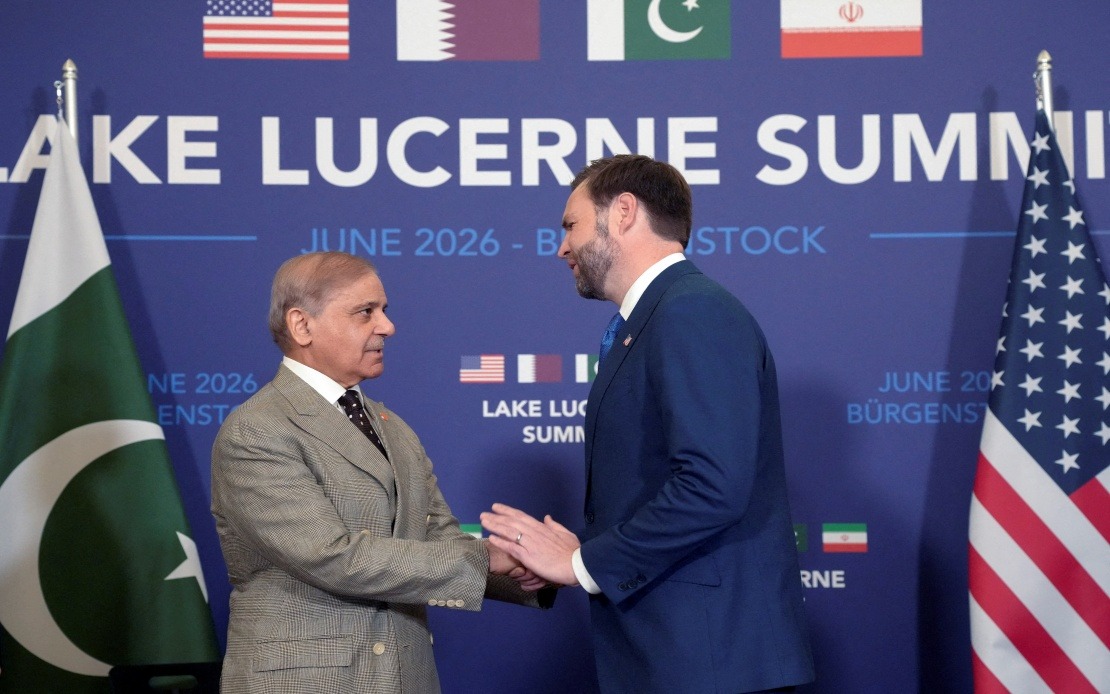
Diplomatic momentum is building in the Swiss resort town of Burgenstock, where United States and Pakistani representatives convened for high-level consultations on Sunday. The meeting brought together Vice President JD Vance alongside special envoys Steve Witkoff and Jared Kushner on the American side, with Pakistan's Prime Minister Shehbaz Sharif and Pakistan Army Chief Field Marshal Asim Munir leading the Pakistani delegation, according to the White House press pool.
The bilateral engagement takes place within a broader multilateral framework aimed at resolving the protracted US-Iran standoff. Technical-level negotiations involving Iran, the United States, and mediator nations Pakistan and Qatar are scheduled to commence simultaneously at the same location, though discussions are being conducted behind closed doors. This parallel arrangement underscores the complexity of managing regional tensions while pursuing concrete diplomatic breakthroughs.
For Pakistan, the involvement signals renewed strategic importance in addressing one of Asia's most consequential geopolitical flashpoints. As a nation with deep historical ties to both Washington and Tehran, Islamabad has positioned itself as a crucial intermediary in these negotiations. The presence of Pakistan's military leadership alongside civilian government representatives indicates the significance Rawalpindi and Islamabad attach to the outcome, given the potential ramifications for regional stability and Pakistan's own security interests.
The diplomatic push follows a recent breakthrough where Iran and the United States inked a memorandum in the early hours of June 18, establishing a framework to terminate the military conflict that erupted on February 28. This accord represents a pivotal shift after months of escalating tensions that had raised concerns about wider regional conflagration. The agreement establishes concrete timelines for reducing military posturing, including specific provisions for Washington to dismantle its naval blockade while Tehran commits to reopening shipping lanes through the Strait of Hormuz—a critical chokepoint controlling roughly one-third of global maritime energy trade.
Iran's nuclear programme remains the substantive core of ongoing discussions. Under the framework agreement, Tehran has committed to non-acquisition of nuclear weapons, though the technical and political details governing this commitment will be negotiated separately. The parties have allocated 60 days for these negotiations to produce binding arrangements. This staged approach allows negotiators to address the most contentious issue—Iran's nuclear ambitions and the International Atomic Energy Agency's role in verification—without letting disagreements derail the broader conflict resolution.
Sanctions relief constitutes the principal incentive for Iranian participation. Tehran expects comprehensive lifting of Western sanctions that have severely constrained its economy for over a decade. The synchronisation of nuclear discussions with sanctions negotiations reflects the interconnected nature of these disputes. Washington's willingness to engage on this front suggests recognition that the military escalation cycle serves neither American nor Iranian interests, and that diplomatic resolution offers a pathway to regional de-escalation.
For Malaysia and other Southeast Asian nations, these developments carry strategic implications. A stabilised Iran-US relationship could reduce global energy price volatility, benefiting oil-importing economies throughout the region. Conversely, any breakdown in negotiations could trigger renewed tensions with unpredictable consequences for shipping, energy markets, and the broader security environment. Pakistan's mediating role also reflects broader Asian diplomatic architecture, where countries like Malaysia, Indonesia, and others often engage in similar balancing acts between great powers.
The White House's emphasis on technical-level negotiations suggests a desire to keep discussions grounded in implementable measures rather than high-level political posturing. By involving special envoys Witkoff and Kushner, the administration signals sustained executive-level commitment to achieving results. Pakistan's participation as both negotiator and mediator positions Islamabad to influence the trajectory of discussions while protecting its own regional interests, including stability along its western border with Afghanistan and Iran.
The coming weeks will prove critical. With negotiations on nuclear arrangements needing completion within two months, pressure exists to move from framework agreements to detailed protocols. Pakistan's continued involvement suggests Washington values Islamabad's perspective on balancing Iranian concerns with broader regional security considerations. As these talks progress, observers across Asia will monitor developments closely, recognising that outcomes in Burgenstock may reshape energy security and geopolitical alignments far beyond the Middle East.

