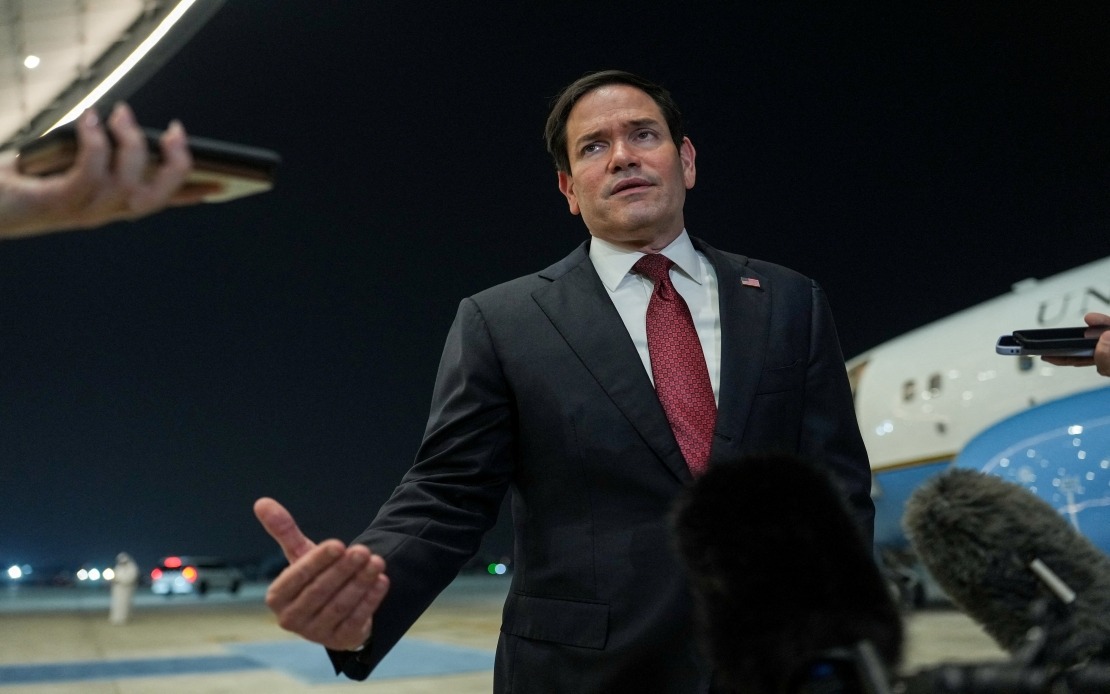
The United States has firmly distanced itself from any proposed reconstruction fund for Iran, according to Secretary of State Marco Rubio, who stressed on Tuesday that Washington will neither invest nor allocate government resources toward such an initiative. Rubio's statement comes as diplomatic momentum builds between the two historically adversarial nations, with recent negotiations yielding tentative progress on multiple security and economic fronts.
Speaking to journalists, Rubio emphasized that determining which parties would contribute to a potential reconstruction fund remained premature and constituted only one element of broader discussions between American and Iranian representatives. He made explicit that American taxpayer money would play no role in financing any such arrangement, drawing a clear distinction between what private entities might pursue and what the federal government would support. This position reflects the Trump administration's cautious approach to re-engagement with Iran, balancing diplomatic openings with fiscal prudence.
The secretary of state suggested that Iran itself possesses the capacity to generate economic opportunities if political conditions permit. However, he coupled this observation with a significant caveat: such economic progress would necessarily depend on Iranian compliance with unresolved security concerns that American policymakers consider fundamental to any lasting arrangement. This framing reflects Washington's demand for concrete Iranian commitment on issues beyond reconstruction finance before normalizing economic relations.
The diplomatic trajectory between the two nations has accelerated considerably in recent weeks. Last Sunday, American and Iranian delegations convened in Burgenstock, Switzerland, with Qatar and Pakistan facilitating negotiations. The American team was headed by Vice President-designate JD Vance, while Iran's parliamentary speaker Mohammad Bagher Ghalibaf led the Iranian contingent. Both sides subsequently reported meaningful progress, suggesting that substantive movement has occurred on multiple disputed issues.
Most significantly, Iran and the United States reached agreement last week on a memorandum that formally terminates the military conflict originating on February 28. This documented settlement establishes concrete timelines for key American concessions, including the lifting of the naval blockade that has constrained Iranian commerce and a commitment to restore Iranian shipping operations through the vital Strait of Hormuz. These provisions address longstanding Iranian grievances and represent meaningful American concessions that could reshape regional commerce.
For Malaysia and Southeast Asian nations dependent on Middle Eastern energy supplies and regional stability, this thawing of US-Iran tensions carries significant implications. The restoration of shipping through the Strait of Hormuz would ease global energy market pressures and reduce the premium paid for maritime insurance in one of the world's most critical chokepoints. Malaysian refineries and petrochemical industries, which rely heavily on stable energy supplies and predictable shipping routes, would benefit substantially from reduced geopolitical risk in the region.
Concurrently, Iran has undertaken substantive nuclear commitments as part of the settlement framework. The country pledges to refrain from pursuing nuclear weapons, with the technical architecture of Iran's nuclear programme to be addressed through a separate negotiating track. This dual-track approach compartmentalizes the most technically complex issues, allowing both sides to demonstrate progress on security matters while specialist teams address nuclear engineering concerns. The parties have established a 60-day window for completing these specialized negotiations, suggesting a structured timeline that could prevent diplomatic stagnation.
Rubio's explicit rejection of American reconstruction funding appears designed to assuage domestic political constituencies concerned about Iranian sanctions relief or American financial support. By drawing bright lines around government involvement, the secretary of state preserves political flexibility while leaving room for private sector engagement or international financial institution participation. This distinction allows for gradual economic normalization without requiring legislative approval or appropriations that could prove politically contentious in Congress.
The reported $300 billion reconstruction fund that generated international speculation last week has proven controversial, with President Trump directly dismissing such figures as exaggerated or speculative. The administration's systematic downplaying of massive aid scenarios suggests an intent to manage expectations and prevent the diplomatic achievement from appearing as capitulation to Iranian demands. This rhetorical positioning protects the agreement from domestic political attacks while maintaining leverage over implementation details.
Regional actors, particularly Gulf states with their own complex relationships with both America and Iran, face uncertainty about their role in any reconstruction framework. Rubio's remarks suggest that if Gulf states choose to invest in Iranian economic recovery, such decisions would remain purely voluntary and divorced from official American policy or financial commitment. This approach preserves American strategic autonomy while potentially encouraging Gulf states to view economic engagement with Iran as their own strategic interest rather than American diktat.
The broader significance of this diplomatic settlement extends beyond Iran-US relations to reshape regional security architecture throughout the Middle East. A stable, commerce-oriented Iran could reduce the structural incentives for regional proxy conflicts that have destabilized countries from Yemen to Iraq. For Southeast Asian nations competing for investment capital and seeking stable markets for their exports, a less militarized Middle East offers economic advantages through enhanced regional predictability and reduced energy price volatility.
Moving forward, implementation will prove as consequential as agreement. The 60-day nuclear negotiating window and the timeline for American naval blockade lifting represent testable commitments that either side could cite as evidence of the other's compliance or violation. Malaysian policymakers monitoring this situation should recognize that American-Iranian rapprochement, while fragile, could gradually recalibrate Middle Eastern geopolitics in ways that indirectly benefit Southeast Asian economic interests through enhanced regional stability and normalized energy markets.

