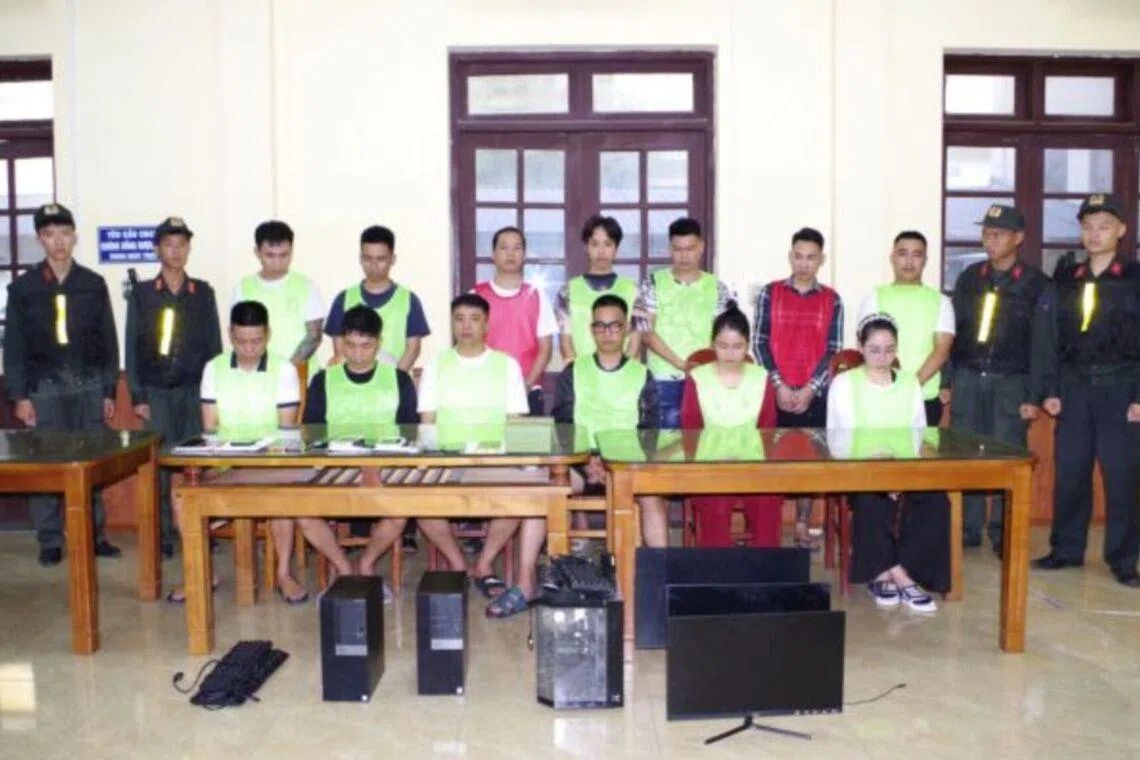
Police in Vietnam's northern Ninh Binh province have successfully dismantled a sophisticated transnational cybercrime syndicate that defrauded victims of more than 250 billion dong, equivalent to RM39.2 million, with 12 arrests made so far. The network, which operated organised scams from Cambodia with clearly delineated roles among its members, targeted approximately 500 victims across Vietnam since October 2024. Officers conducting raids recovered substantial physical evidence including cash, a motor vehicle, mobile phones, computers, forged identity documents, jewellery and extensive operational records that reveal the scope and complexity of the criminal enterprise.
The investigation identified Nguyen Van Cuong, 28, and Nguyen Van Phuong, 34, as the principal architects of the scheme. Rather than operating strictly within Vietnam's borders, the criminal group employed a sophisticated human trafficking component, recruiting Vietnamese nationals and transporting them across the border to Cambodia where the actual fraud operations were coordinated. This transnational structure created enforcement challenges and suggests the network sought to exploit jurisdictional limitations that might complicate law enforcement cooperation.
The scope of deception employed by the syndicate reveals the evolving sophistication of cybercriminals targeting Southeast Asia. Members impersonated an extensive range of authority figures, including police officers, prosecutors, judges, banking sector employees and tax officials. These fraudsters leveraged the psychological weight of governmental authority to overcome victims' natural scepticism, a tactic that has proven particularly effective across the region where public trust in official channels remains relatively high. By assuming these identities through phone calls, messages and digital interactions, the criminals created artificial urgency and legitimacy that pressured victims into compliance.
Technological deception formed the second pillar of their operation. The group constructed counterfeit websites and mobile applications designed as pixel-perfect replicas of genuine government agencies and established commercial enterprises. Malaysian and Southeast Asian internet users may recognise this tactic, as similar operations have targeted citizens across the region. The fraudsters invested effort into making these fake digital platforms appear authentic, including duplicating official branding, security features and user interface elements. This technical sophistication suggests involvement of individuals with genuine coding and design capabilities, indicating the criminal operation extended beyond simple con artists to include technological specialists.
The criminal network deployed multiple distinct scam scenarios tailored to different victim profiles and circumstances. Schemes ranged from deceptive online recruitment advertisements promising legitimate part-time work opportunities, to fraudulent investment vehicles centred on financial products, securities and cryptocurrency. Romance scams formed another revenue stream, with perpetrators building false emotional relationships online before requesting money transfers under various pretexts. Additionally, the group hijacked legitimate social media accounts belonging to real users, then exploited these compromised profiles to solicit loans from the victim's own contacts, adding a layer of credibility through apparent peer-to-peer interaction.
One particularly elaborate scheme involved members posing as military procurement officers who contacted retail shops and commercial businesses with substantial orders. The fraudsters then convinced victims to purchase additional merchandise on their behalf, with assurances that payment would follow. Victims were instructed to transfer deposits or advance payments to bank accounts controlled by the criminals, who subsequently disappeared with the funds. This specific con demonstrates deep understanding of business payment practices and supply chain vulnerabilities in Vietnam's commercial sector, suggesting the network included individuals with legitimate business experience.
Criminal investigations have resulted in formal charges against six of the detained suspects with fraudulent appropriation of property, with these individuals currently held in temporary detention pending trial. Authorities have implemented procedural measures against the remaining six suspects as investigators continue gathering evidence and building cases. The police have signalled their intention to expand investigations to identify and apprehend additional network members, suggesting the 12 arrested individuals represent a portion of a larger organised structure. This staged approach to arrests is typical of transnational investigations where authorities seek to map the full extent of criminal networks before moving against peripheral members.
Asset recovery represents a significant component of the ongoing response, with authorities taking steps to identify, seize and freeze financial holdings belonging to the suspects. This dimension addresses the practical reality that victims may recover compensation only if investigators can locate and preserve stolen funds before they are transferred, laundered or spent. Given the magnitude of the total loss—RM39.2 million—success in asset freezing could substantially ease victim compensation efforts. The investigation's expansion suggests police are pursuing both individual perpetrators and the financial infrastructure that sustained the operation.
This case carries particular relevance for Malaysian authorities and residents, as similar transnational fraud networks inevitably target Malaysian victims and may operate from or coordinate through Malaysian territory. The operation's use of Cambodia as a base reflects a troubling trend of organised cybercrime groups establishing sanctuaries in jurisdictions where regulatory oversight remains limited. The methods documented in the Ninh Binh investigation—fake government impersonation, counterfeit digital platforms, romance scams and account hijacking—are not unique to Vietnam but represent standard tactics deployed across Southeast Asia. Malaysian residents should recognise these red flags in their own online interactions.
The scale of victim numbers and financial losses underscores the regional challenge posed by organised online fraud. In Southeast Asia's increasingly digital economy, where financial services, government interactions and social relationships migrate online, such criminal infrastructure finds abundant opportunity. The sophistication evident in this case, including dedicated roles, technological capabilities and multi-layered deception strategies, demonstrates that cybercrime has evolved beyond individual opportunists toward structured criminal enterprises comparable to traditional organised crime groups. Authorities across the region, including Malaysia, must coordinate responses and share intelligence about operational methods and suspect networks to disrupt these transnational operations effectively.

