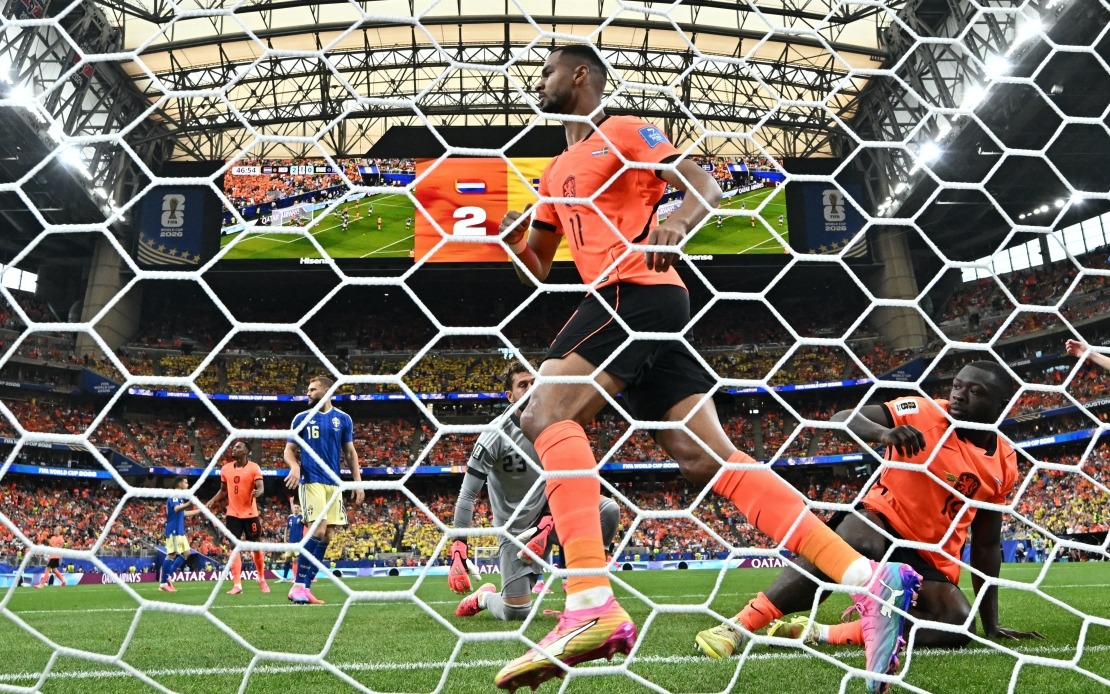
The 2024 World Cup has established itself as a remarkably prolific tournament, hitting the century mark for goals scored in just 33 matches—the fastest pace achieved since Switzerland hosted the competition in 1954. Cody Gakpo's strike during the Netherlands' demolition of Sweden, which ended 5-1, served as the symbolic 100th goal, setting a pace of 3.03 goals per match that has already captured global attention and sparked debate about what is driving the unprecedented offensive showcase.
When the 1954 World Cup reached 100 goals, it required only 20 matches, a record that has stood unchallenged for seven decades. The current tournament's achievement in 33 matches represents the second-fastest milestone in World Cup history, narrowing a gap that once seemed insurmountable. By contrast, the 2014 tournament in Brazil needed 36 matches to reach this threshold, while Spain 1982 also required the same number. The 1978 tournament in Argentina and the 1994 edition hosted by the United States both took 38 matches, demonstrating that the contemporary pace is genuinely exceptional and warrants serious examination.
Several factors have converged to produce this offensive explosion. The official tournament ball, marketed as the Trionda, has drawn particular scrutiny from analysts who believe its design characteristics may have compromised goalkeeper positioning, especially on long-range attempts. Data suggests that fully 10 goals have been scored from outside the penalty area, a notably high proportion that some attribute directly to these aerodynamic properties. The ball's behaviour in flight appears to present challenges that modern goalkeepers, despite their elite training and experience, have struggled to compensate for consistently.
Environmental conditions have also played a measurable role in the high-scoring trend. The heat experienced across venues has manifested in player fatigue that appears to translate into defensive vulnerabilities, particularly in the latter stages of matches. Tournament organisers' decision to implement mandatory three-minute cooling breaks has inadvertently created additional strategic opportunities for coaching staff. These stoppages allow tactical recalibrations and fresh tactical instructions at critical junctures, potentially disrupting defensive shape and enabling attacking teams to reorganise their approaches with renewed intensity.
The structural change to include 48 teams rather than the traditional 32 has inevitably altered competitive dynamics. Early results seemed to support concerns that this expansion would produce lopsided matches: Germany's 7-1 destruction of Curaçao, Canada's 6-0 demolition of Qatar, and Tunisia's back-to-back heavy defeats to Sweden (5-1) and Japan (4-0) all appeared to validate fears about quality disparities. However, a more nuanced picture has emerged through closer examination of the tournament's broader pattern.
Balancing these seemingly one-sided contests are results that demonstrate competitive integrity remains largely intact. Curaçao managed to hold Ecuador to a goalless draw, a result that would have seemed improbable beforehand given the perceived gulf in quality. Cabo Verde, playing against a Spanish team widely regarded as among the tournament favourites, frustrated their opponents in another 0-0 stalemate that showcased defensive organisation and tactical discipline. Qatar's performance against Canada proved particularly instructive: despite ultimately losing 6-0, the team played much of the match with nine men following red card dismissals, suggesting the scoreline exaggerated the actual competitive gap.
Underdogs such as Jordan and Uzbekistan have provided further evidence that the expanded format has not simply created a procession of predetermined outcomes. Both sides mounted competitive challenges despite falling 3-1 to Austria and Colombia respectively, indicating they possessed the tactical apparatus and player quality to make matches contestable rather than forgone conclusions. These results collectively suggest that while the 48-team format does create opportunities for larger winning margins, it has not fundamentally compromised competitive balance to the extent some anticipated.
The high-scoring environment carries implications for Southeast Asian football enthusiasts and aspiring players studying international competition. Malaysia and other regional nations competing in World Cup qualification can observe that offensive methodology and aggressive tactical approaches have yielded rewards in this tournament, potentially influencing how regional teams construct their playing philosophies. The data suggests that defensive solidity, while necessary, may prove insufficient without corresponding attacking ambition and clinical finishing.
Further, the ball specifications and environmental factors identified as contributors to goal-scoring productivity offer practical lessons for training methodologies. Teams can emphasise long-range shooting practice and defensive positioning adjustments to counter modern ball technology. The cooling breaks introduce an additional tactical variable that coaches at all competitive levels might incorporate into their strategic frameworks, recognising that match management now extends beyond pure substitution policy.
The tournament's expansion itself raises questions about the future trajectory of World Cup format, particularly regarding whether subsequent editions will maintain this 48-team structure. The evidence thus far suggests that expanding participation has enhanced rather than diminished competitive unpredictability, contrary to pre-tournament scepticism. The balance between creating opportunities for emerging football nations and maintaining elite competitive standards appears to have shifted in this instance toward inclusion without sacrificing entertainment value or genuine competitive drama.

