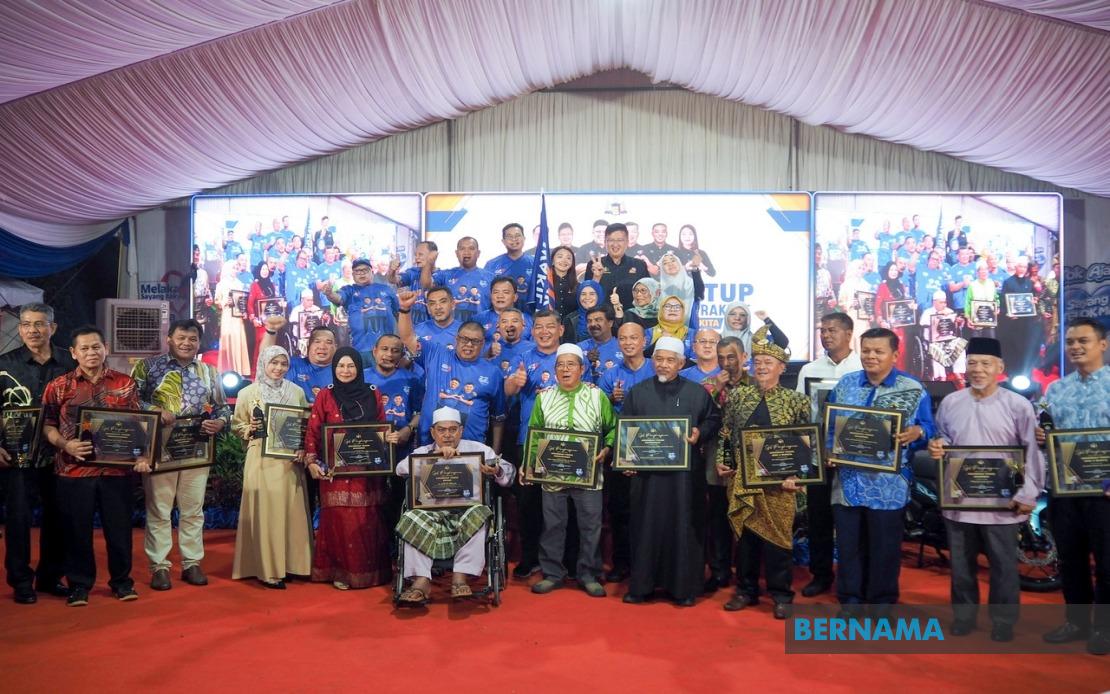
Melaka Chief Minister Datuk Seri Ab Rauf Yusoh has reframed how the state evaluates the performance of its Wakil Rakyat Untuk Rakyat (WRUR) Programme, arguing that meaningful governance should be judged by tangible improvements in citizens' lives rather than the sheer number of activities rolled out. Speaking at the closing ceremony of the WRUR initiative in the Kota Melaka parliamentary constituency, Ab Rauf underscored a philosophy increasingly relevant across Southeast Asia, where public frustration with grandiose announcements often outpaces visible results on the ground.
The WRUR approach fundamentally rests on a grassroots-focused model designed to capture and act upon citizen concerns at the community level. According to the Chief Minister, the programme ensures that complaints originating from any background or geographical location receive proper documentation and responsive action. This ground-up strategy contrasts with top-down governance models that sometimes struggle to translate policy into lived experience. For Malaysian readers familiar with delayed infrastructure projects or unresolved municipal grievances, such emphasis on complaint tracking and resolution resonates with broader calls for accountability in public administration.
Data released from the 19 state constituencies that have so far participated in WRUR reveals a resolution rate that officials consider encouraging. Of 4,027 complaints documented across these constituencies, authorities have successfully addressed more than 2,633 cases, representing a 65 per cent completion rate. While such figures merit scrutiny regarding what constitutes genuine "resolution" versus bureaucratic closure, the transparency in reporting these numbers itself signals an attempt to ground programme evaluation in concrete outcomes. The remaining unresolved complaints, Ab Rauf stressed, will not be abandoned once the programme formally concludes but will continue to receive attention from relevant agencies prioritised by urgency.
Kota Melaka represents the third parliamentary constituency to undergo the WRUR initiative, following earlier implementations in Alor Gajah and Hang Tuah Jaya. During the four-week implementation window, the programme generated over 500 distinct activities spanning five state constituencies and directly benefiting more than 200,000 residents. Within the Kota Melaka constituency specifically, the programme documented 470 complaints, with 31 resolved during the campaign period itself and others proceeding through the established prioritisation framework.
State Tourism, Heritage, Arts, and Culture Committee chairman Datuk Abdul Razak Abdul Rahman provided additional context by highlighting development achievements in the Telok Mas state constituency. Over the preceding five years, 328 localised projects valued at nearly RM68 million have been executed, spanning improvements to transport infrastructure, water management systems, residential rehabilitation, and community facilities. Such investments reflect the integrated approach increasingly seen across Malaysian states, where elected representatives attempt to address multiple dimensions of community need simultaneously.
Welfare and assistance programmes have constituted a substantial component of official activity in the Telok Mas area. Between food assistance, welfare provisions, and health support valued at over RM1.2 million, approximately 6,098 residents have benefited directly. The distribution of 213 medical beds to households in need addresses a healthcare accessibility gap often overlooked in urban-focused policy discussions. Additionally, 70 iterations of the Jualan Rahmah and Jualan Murah schemes launched since 2022 represent attempts to cushion households against inflationary pressures, whilst the Free Petrol Programme has extended fuel subsidies to roughly 15,000 residents worth RM177,000 collectively.
Educational support has emerged as another priority lever. Within Telok Melaka, 1,694 secondary students preparing for SPM examinations received targeted assistance. Separately, 255 high-performing Form Five students and undergraduates from public tertiary institutions secured educational incentives totalling RM244,200. These interventions acknowledge that upward mobility for lower-income households depends substantially on educational access and financial freedom from immediate economic pressures during critical academic periods.
Looking forward, tourism development represents an explicit economic diversification strategy for the Melaka region. The Ministry of Tourism, Arts and Culture has allocated RM2.4 million toward upgrading tourism infrastructure in Sungai Punggor and Alai, with completion anticipated by 2027. An additional RM300,000 investment will transform Dataran Telok Mas into a One-Stop Centre consolidating tourism promotion with local artisan and traditional product sales. These initiatives acknowledge the potential for heritage tourism to generate sustainable income for communities whilst preserving cultural identity.
Geological heritage has also entered the economic calculation. The Bukit Larang geosite has been designated a keystone location within the Melaka Geopark framework, with formal assessment for National Geopark status scheduled for October. Such recognition, if achieved, could catalyse both tourism visitation and science education activities whilst establishing environmental protection standards. For Southeast Asian jurisdictions increasingly conscious of sustainable development imperatives, geopark designation represents a strategic alignment of conservation, education, and economic opportunity.
The philosophical reorientation Ab Rauf articulates—prioritising effectiveness over volume—carries broader implications for governance evaluation across Malaysia and the region. As constituencies become more digitally connected and informed, citizens increasingly demand demonstrable results rather than activity reports. The WRUR model's emphasis on complaint documentation, systematic resolution tracking, and continued attention beyond formal programme closure suggests an emerging maturity in how elected officials conceptualise accountability. Whether this represents genuine institutional transformation or strategic messaging remains an open question; sustained implementation and independent verification of complaint resolution will ultimately determine whether the WRUR approach translates rhetoric into durable improvements in service delivery and public satisfaction across Melaka's diverse communities.

