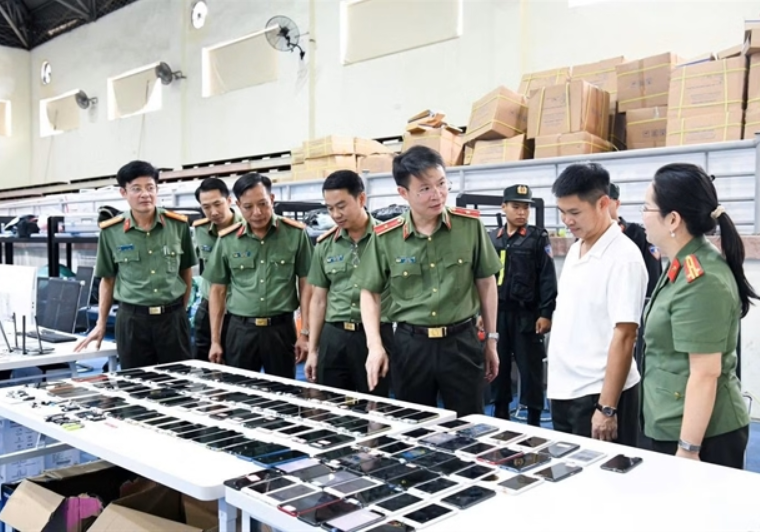
Police in the northern province of Phu Tho have successfully disrupted what investigators describe as a carefully orchestrated attempt to relocate a major online scam operation from Cambodia into Vietnamese territory. The case, which came to light on June 18, resulted in charges against four individuals and represents a significant victory in regional efforts to combat transnational cybercrime networks that have become increasingly mobile across Southeast Asia.
The investigation centred on a sophisticated relocation scheme that exemplifies how criminal enterprises are adapting to heightened law enforcement pressures in key operating jurisdictions. As authorities in Cambodia intensified their crackdown on illicit call centres and online fraud rings, the network identified an opportunity to shift operations across the border into Vietnam, where officials believed they could establish a foothold before detection. This pattern of geographic arbitrage—where criminals move operations to jurisdictions with perceived enforcement gaps—has become a hallmark of transnational fraud organisations in the region.
Zhao Wei Zhong, a 37-year-old Chinese national, served as the operational architect for this relocation effort. Police determined that Zhao entered Vietnam on explicit instructions from an overseas associate, suggesting the plot was part of a larger hierarchical criminal structure with international coordination. His specific mandate was to establish the essential infrastructure required for a large-scale fraud operation, including identifying suitable premises and arranging logistics for the anticipated arrival of dozens of workers from the Cambodian base.
Zhao's background proved invaluable to the conspiracy's planners. Having previously worked at Chinese-operated scam operations in Cambodia, he possessed intimate knowledge of how such enterprises function and the specific requirements needed to establish a functioning call centre. More significantly, during his time in Cambodia, he had cultivated relationships with Vietnamese nationals who could facilitate the operation's transition across the border and into local communities where the scam hub would be concealed.
Two of those Vietnamese accomplices were identified as Tran Thi Thu Huong, 24, and Dình Nam, 27, both from Bac Ninh province. Police documented how Zhao systematically recruited this pair to handle crucial support functions that would be difficult for foreign operatives to execute independently. Huong and Nam provided translation services, scouted potential locations to house the incoming workforce, and arranged transportation logistics. Their involvement demonstrates how international crime rings strategically co-opt local residents to overcome language barriers and blend illicit operations into their surroundings.
A fourth suspect, Nguyen Thanh Long, a 43-year-old Hanoi resident, occupied a support role in the broader conspiracy. Investigators determined that Long's responsibility involved coordinating additional logistical arrangements that would enable the operation to become self-sufficient once personnel arrived from Cambodia. The collaborative structure of the network reveals how these organisations compartmentalise functions across multiple participants to reduce individual exposure and enhance operational resilience.
The sophistication of the planned operation became apparent when authorities conducted searches at properties connected to the conspirators. Police seized substantial quantities of equipment intended for the call centre infrastructure, including 73 computers, 134 mobile phones, 34 USB drives, and 20 Wi-Fi routers. This haul underscores the technical apparatus required to execute modern-day online fraud schemes at scale, which typically involve dozens of operatives simultaneously managing multiple fraudulent interactions with victims across various countries and time zones.
Authorities successfully prevented the conspiracy from advancing to an operational stage, dismantling the network before any employees could be transferred from Cambodia or before the scam centre could generate its first fraudulent transactions. This proactive intervention—achieved through early detection and investigation—prevented what could have become a significant criminal enterprise operating on Vietnamese soil.
Following an evidence-gathering phase, charges were formally filed on June 17 against Zhao, Huong, and Long for organising the illegal residence of foreign nationals in Vietnam. This charge, while appearing narrow in scope, is strategically significant because it targets the foundational illegality underpinning the entire operation. All three were ordered into pretrial detention, reflecting the seriousness with which authorities view their roles. Nam received the same charge but faced the less stringent measure of a movement restriction order, confining him to his residence pending trial proceedings, suggesting possible cooperation or a lesser culpability determination.
The case illustrates a persistent challenge facing Southeast Asian law enforcement: the fluidity of transnational criminal operations that respond rapidly to enforcement actions by shifting jurisdiction. Vietnam's success in this instance reflects improving coordination between regional intelligence agencies and enhanced capacity to identify inbound criminal infrastructure before it becomes operational. However, the very fact that such networks continue attempting relocation strategies indicates ongoing vulnerabilities in cross-border law enforcement cooperation and the persistent financial incentives driving online fraud enterprises in the region.

