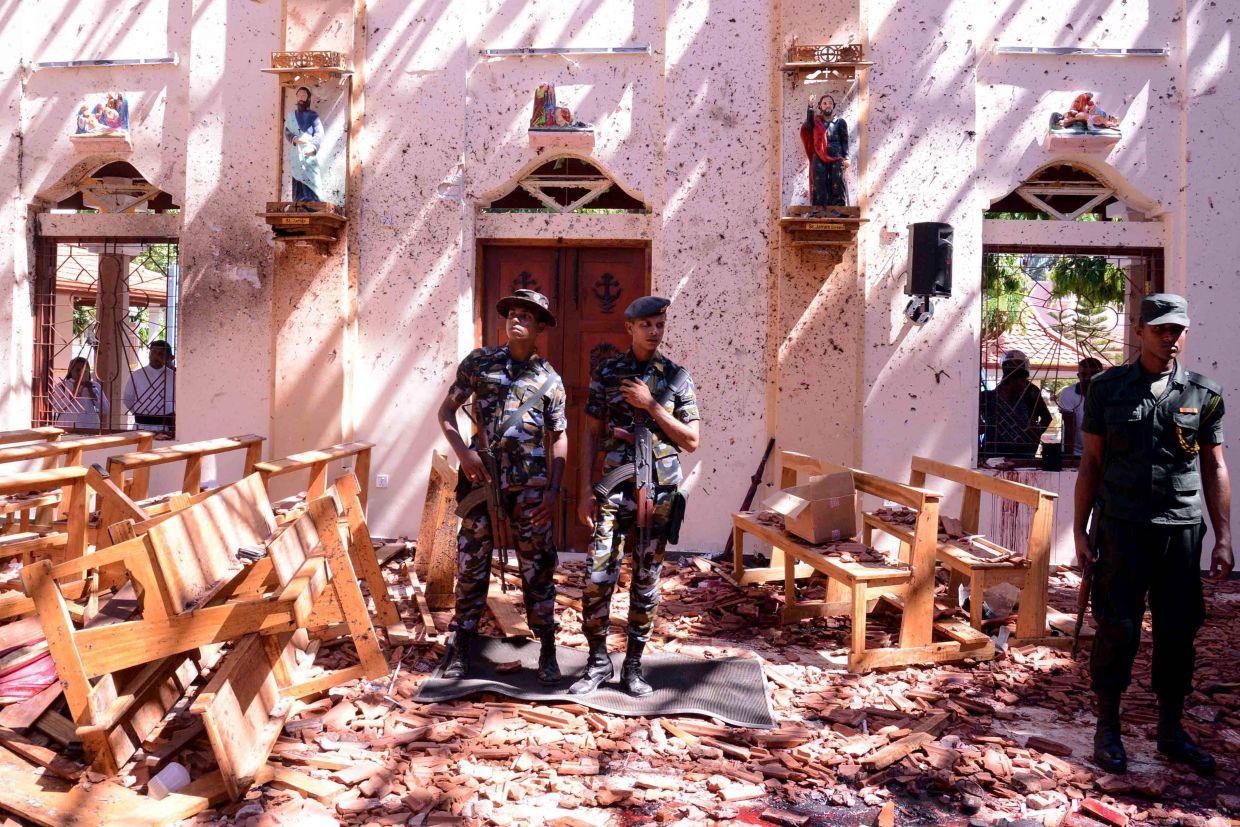
A retired Sri Lankan major general with international credentials addressing the Pentagon and the United Nations on counterterrorism has become the focal point of a darkening political controversy. Suresh Sallay, whose expertise on terrorism and social media radicalisation earned him a platform at the world's highest security forums, was arrested in February under anti-terrorism legislation and accused by his own government of directing the deadliest peacetime attack in the nation's modern history. The reversal underscores how dramatically the official narrative surrounding the April 21, 2019 Easter bombings has shifted, transforming what authorities initially presented as an Islamist militant operation into an alleged conspiracy involving state security apparatus and powerful political interests.
The Easter bombings were catastrophic in scale and impact. Coordinated suicide attacks on three luxury hotels and three churches killed 279 people and wounded over 500 others. The victims included 45 foreigners—tourists and visitors from Australia, Britain, China, Denmark, the Netherlands, Japan and the United States—making it an event of international significance that dominated global news coverage for weeks. Initial investigations blamed Sunni Muslim suicide bombers inspired by the Islamic State group, a narrative that shaped Sri Lanka's security policy and political discourse in subsequent years. Yet within months, questions emerged about how such a devastating coordinated attack had evaded detection despite foreign intelligence warnings, particularly from Indian agencies that had flagged potential threats before the bombings occurred.
Public Security Minister Ananda Wijepala laid out the government's current position to parliament in June, describing Sallay as the "mastermind" who "conspired with and strategically directed Islamic extremists until they carried out the attacks." The minister provided specific details, claiming that Sallay met Muslim men just three weeks before the bombings to gather intelligence on target locations. This direct accusation from a government minister escalated what had been investigative whispers into official policy, essentially declaring that the nation's former intelligence chief orchestrated mass murder to serve political ambitions. Sallay, who has not been formally charged despite months in custody, maintains his innocence and awaits a court hearing scheduled for mid-July.
The emerging narrative suggests a calculated conspiracy far more sinister than spontaneous extremist violence. Multiple investigative threads point toward state security agencies cultivating an alleged jihadist network not primarily to combat terrorism, but to create a security crisis that would benefit specific political actors. Critics and investigators argue that the attack was permitted to unfold as part of a strategy to position Gotabaya Rajapaksa, who was contesting the 2019 presidential election, as a decisive strongman capable of crushing Islamist militancy. This argument draws parallels to Rajapaksa's military reputation from his role as defence secretary during the 2009 conclusion of the civil war against Tamil rebels. A 2023 Channel 4 investigation cited a whistleblower alleging the attack was deliberately allowed to proceed to secure Rajapaksa's electoral victory on a law-and-order platform.
Historical context deepens the plausibility of such allegations. Rajapaksa administrations have previously acknowledged that the state funded and cultivated jihadist networks during the 1983-2009 civil war, ostensibly to gather intelligence on Tamil militant movements. While authorities claim these operatives subsequently betrayed their handlers and acted independently during the Easter attacks, the admission itself establishes a troubling precedent of state-directed militant operations within Sri Lanka's security infrastructure. This creates a documented pattern of blurred lines between intelligence management and potential manipulation of extremist groups for political purposes. The question becomes not whether such arrangements were possible, but whether safeguards existed to prevent their abuse.
Sallay's personal profile complicates the narrative in ways that illuminate Sri Lanka's underlying tensions. As a Muslim married to a Buddhist, with a Catholic mother who has appealed to the Pope for his release, Sallay embodies the religious pluralism that theoretically characterises modern Sri Lanka. His international education—including studies at India's prestigious National Defence College, Madras University and Britain's University of Bradford—and his postings to Sri Lankan missions in France and Malaysia marked him as a cosmopolitan professional. His 2003 Pentagon address on suicide terrorism and his 2023 UN speech warning of social media's role in radicalisation positioned him as a serious analyst of contemporary security challenges. Yet this very respectability may have made him valuable as a figure to blame, offering apparent credibility to accusations while neutralising a potential critic of security operations.
The treatment of others in the alleged conspiracy raises additional concerns about the investigation's direction and fairness. Hejaaz Hizbullah, a Muslim human rights lawyer, was arrested in 2020 and accused of masterminding the Easter attacks—the same year Sallay headed the State Intelligence Service following Rajapaksa's election victory. Hizbullah remained in custody for 22 months before authorities released him without producing evidence linking him to the bombings. His detention and subsequent release without charges exemplifies what human rights observers characterise as arbitrary use of anti-terrorism legislation against Muslim figures. The pattern suggests investigations may be driven by identity politics and power consolidation rather than genuine pursuit of accountability.
Demographic context matters significantly for understanding how such accusations gain traction in Sri Lanka. With nearly 70 percent of the population Buddhist, 12 percent Hindu, 10 percent Sunni Muslim and 7 percent Christian, Muslims constitute a distinct minority whose security concerns carry less political weight than those of the Buddhist majority. In post-2019 electoral politics, particularly as Rajapaksa cultivated alignment with radical Buddhist nationalist groups, portraying Islam-associated figures as threats to national security becomes politically useful. Accusing respected Muslim professionals of orchestrating terrorism serves multiple functions: it justifies aggressive security operations targeting Muslim communities, it neutralises potential critics with security expertise, and it reinforces narratives positioning Rajapaksa-aligned forces as protectors of the Buddhist nation.
The judicial process now unfolding will determine whether Sallay receives the fair hearing fundamental to any functioning justice system. His scheduled court appearance represents a critical juncture where evidence must substantiate the extraordinary allegations or be exposed as politically motivated persecution. The charges carry implications far beyond one individual's fate. They touch upon fundamental questions about democratic governance, minority rights, separation of powers between security agencies and political leadership, and whether Sri Lanka's justice system can function independently or has become merely an instrument of executive power. International observers, including potentially the international community that has repeatedly expressed concern about Sri Lanka's post-conflict democracy, will watch this proceeding closely.
For regional observers, particularly those in Southeast Asia where several nations confront similar tensions between security operations and democratic accountability, the Sallay case exemplifies how counterterrorism frameworks can be subverted. When security agencies answer to political leaders rather than constitutional oversight, when intelligence operations blur lines between legitimate threat prevention and engineered crises, and when respected professionals can be arrested without evidence purely for alleged disloyalty, the entire architecture of democratic governance weakens. Malaysia and other ASEAN nations with significant Muslim populations and their own histories of security-related political tensions find in Sri Lanka's experience cautionary lessons about the fragility of institutions when security considerations override legal protections. Whether Sallay ultimately faces conviction or vindication, the investigation itself has already damaged trust in Sri Lanka's security institutions and highlighted governance vulnerabilities that extend across the region.

